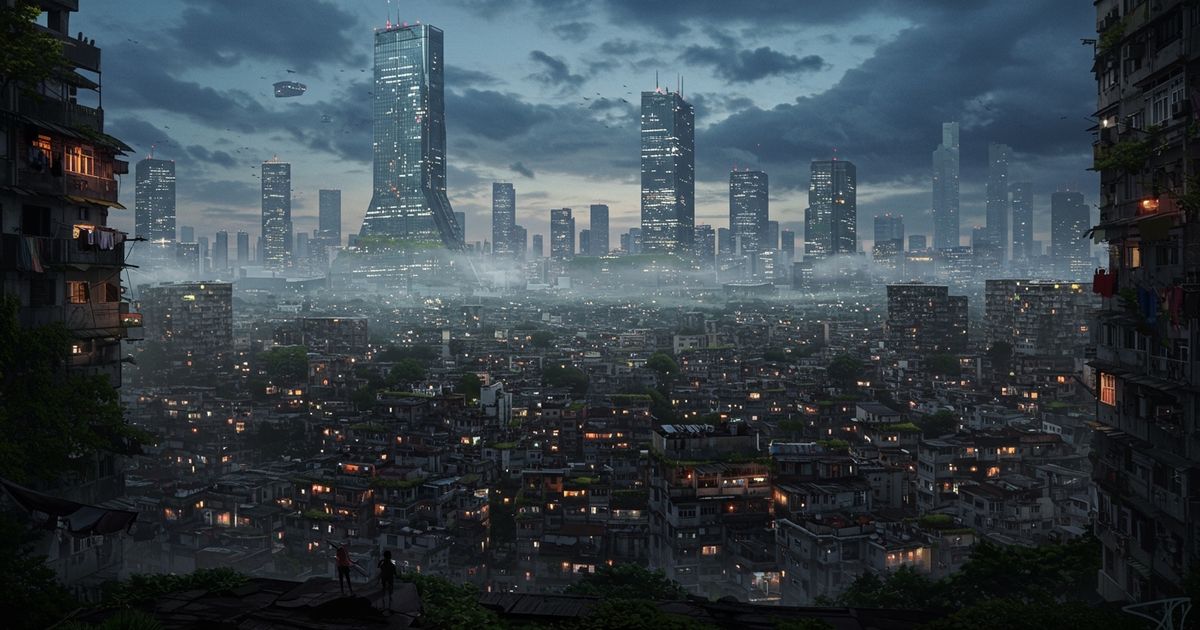
Ever looked at the ruins of an ancient city, like the Colosseum or the pyramids, and wondered what happened to the people who built them? Why did mighty empires, seemingly invincible, just vanish or crumble away? It’s a question that has haunted historians and archaeologists for centuries, and it’s not just about the past – it’s a question that might hold the key to our own future.
Background
For a long time, researchers have been piecing together the puzzles of past collapses. From the Roman Empire, which slowly dissolved over centuries, to the Mayan civilization, whose grand cities were swallowed by the jungle, and even the isolated people of Easter Island, who depleted their own resources, history is full of societies that didn’t make it. What scientists have learned is that these collapses aren’t usually sudden. They’re often slow burns, with warning signs building up over generations.
Think of it like a car slowly developing problems. At first, it’s just a strange noise. Then, the engine starts to sputter. Eventually, it breaks down entirely. For ancient civilizations, these “sputters” often included things like a growing gap between the rich and the poor – where a small group of elites hoarded resources while most people struggled. Another big red flag was when people stopped trusting their leaders or the system itself. When folks lose faith in the government or feel like the rules only apply to some, it’s a recipe for trouble.
But here’s the million-dollar question: what about us? We live in a truly global, technological society. Our cities are interconnected, our economies are intertwined, and our science can do things that would seem like magic to our ancestors. Does the fate of the Romans or Mayans even apply to a world with smartphones, space travel, and instant communication? New research dives into this very question: what kinds of modern civilizations are most likely to fall apart, and which ones have a shot at enduring?
Discovery
The core of this new understanding is that modern, technological societies face both old and new challenges. It’s not just about repeating history; it’s about how those historical patterns play out on a global stage, amplified by our amazing, yet sometimes dangerous, advancements.
Imagine our global civilization as a massive, intricate machine. Every country, every economy, every person is a gear, a lever, or a circuit board. For this machine to run smoothly, all its parts need to work together. And crucially, it needs fuel and maintenance.
One major finding echoes the past: inequality is a societal toxin. When wealth and power are concentrated in very few hands, it’s like our machine only has a few perfectly polished gears, while the rest are rusty and seizing up. This creates instability. In other words, when a small elite class thrives while the majority struggles, resentment builds. People feel unheard, unrepresented, and exploited. Historically, this has led to social unrest, rebellions, and a breakdown of the social fabric. In our globalized world, this isn’t just local; it can spark movements and conflicts that ripple across continents. Think of it like a virus: a localized problem can quickly become a global pandemic.
Another critical factor is trust. Or rather, the lack of it. If the machine’s operators (our leaders and institutions) lose the trust of the people who rely on it, the whole system becomes fragile. When citizens distrust scientific experts, the media, or their governments, it makes tackling big problems almost impossible. How do you fight climate change or a pandemic if a significant portion of the population doesn’t believe the warnings or the solutions? This erosion of trust is like the wires in our global machine becoming frayed and disconnected. Information stops flowing, and effective action grinds to a halt.
But our modern world also introduces entirely new collapse drivers. Unlike past civilizations that might have exhausted local forests or farmland, we face global environmental crises. We’re talking about climate change, loss of biodiversity, and ocean pollution. These aren’t just local problems; they are stressors on the entire planetary system that our global machine relies upon. It’s like the very ground our machine sits on is starting to crack and melt, threatening to swallow it whole. When natural disasters become more frequent and severe, food and water supplies are disrupted, and populations are displaced, it puts immense pressure on our social and political systems.
Finally, there’s the issue of complexity and adaptability. Our global technological civilization is incredibly complex, like a supercomputer with billions of lines of code. This complexity makes us incredibly powerful, but also incredibly vulnerable. If one critical part of the system breaks down – say, a major supply chain is disrupted by a pandemic or a war – it can have cascading effects worldwide. Think of it like a domino effect: one falling domino triggers a chain reaction across the globe. Civilizations that are too rigid, too specialized, or too slow to adapt to new challenges are more likely to collapse. The societies that endure are those that can learn, innovate, and change their fundamental structure when faced with new realities. They are like a machine that can reconfigure itself, changing its parts and even its purpose to survive new conditions.
So, what about the civilizations that endure? The research suggests it’s not about being immune to challenges, but about how a society responds. Those that foster cooperation, equitable sharing of resources, and a willingness to adapt are far more resilient. They build social structures that reduce inequality, maintain public trust, and invest in sustainable practices. They view problems as opportunities for collective action, not just individual gain.
Significance
This research isn’t just a grim history lesson; it’s a vital guidebook for our present and future. By understanding the common threads between past collapses and the new challenges of our technological age, we can start to see the warning signs in our own society. It helps us understand that issues like political polarization, economic disparity, and environmental degradation aren’t just isolated problems. They are interconnected symptoms of potential civilizational instability.
This knowledge empowers us. It shows us that collapse isn’t inevitable, but a result of choices. It suggests that by tackling issues like wealth inequality, rebuilding trust in institutions, and aggressively addressing climate change, we’re not just solving individual problems – we’re actively building a more resilient and enduring civilization. It shifts our perspective from just reacting to crises to proactively designing a future where humanity thrives.
Outlook
So, what’s next? Can we use this understanding to “engineer” a civilization that truly endures for millennia? The research opens up fascinating possibilities. Scientists can continue to model these complex systems, using data from history and current events to identify tipping points – those crucial moments when a system can either recover or spiral into collapse.
Imagine developing “early warning systems” for civilizational health, much like meteorologists predict weather patterns. We could monitor key indicators like wealth distribution, public trust levels, and resource consumption to identify risks before they become catastrophes. We might even explore how different forms of governance or economic systems could foster greater resilience.
Ultimately, this research leaves us with a powerful message: our future isn’t predetermined. The fate of our global technological civilization rests on the choices we make today. Will we learn from the ghosts of empires past and adapt to the challenges of the future? Or will we let the rust and friction of inequality, distrust, and environmental stress slowly grind our magnificent global machine to a halt? The answer, as always, is up to us.