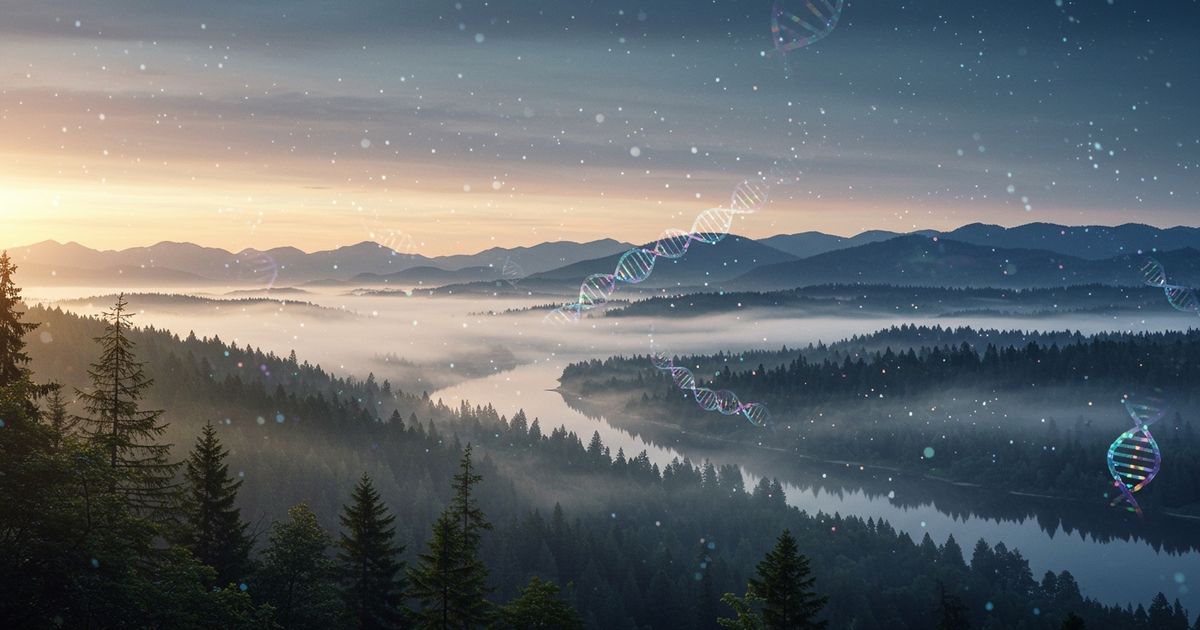
Every Breath You Take Contains a Secret
Right now, floating through the air around you, there is DNA. Not from humans (well, mostly not) — but from trees, fungi, insects, bacteria, and hundreds of other living things you’d never notice just by looking around. Every living thing sheds its genetic material constantly, like a biological breadcrumb trail. And scientists have figured out how to read it.
Welcome to the world of environmental DNA — or eDNA for short. Think of it as nature’s invisible fingerprint, drifting on the breeze.
Life Leaves Traces Everywhere
You already know that living things shed stuff. Humans leave behind skin flakes, hair, and saliva. Dogs track mud everywhere. Plants drop pollen. What you probably didn’t realize is that all of this material contains DNA — the molecular instruction manual that makes every living thing what it is.
For years, scientists have collected eDNA from water. Drop a filter into a lake, and you can detect what fish live there just from the genetic traces they’ve left behind — no fishing rod required. It’s like reading a guest list from the crumbs left at a party.
But water is easy. Air is a whole different challenge. The DNA floating through the atmosphere is fragile, sparse, and mixed in with an enormous amount of… everything else. Dust, pollen, pollution, random particles. Separating the signal from the noise is incredibly difficult.
Recently, though, researchers have cracked the code. And what they’re finding is genuinely remarkable.
Nature’s Invisible Roll Call
Here’s the core idea: scientists set up air-sampling devices — basically very sophisticated vacuum cleaners — that suck in huge volumes of air and trap whatever’s floating in it. Then they run the collected material through genetic analysis, a process that can identify which organisms left their DNA behind.
Think of it like taking attendance in a classroom, but you never actually see the students. You just find their handwriting on tiny scraps of paper blowing around the room, and from the handwriting alone, you can figure out exactly who was there.
The results have been stunning. In a single air sample from a forest, scientists have detected dozens of tree species, hundreds of fungal types, insects, birds, and even mammals — all without ever seeing them directly. In cities, the air carries DNA from an almost surreal mix of sources: rats, pigeons, ornamental plants, mold, and yes, humans too.
In other words, the air is essentially a living library. Every cubic meter of it is packed with biological information about the ecosystem it passed through.
Three Big Ways Scientists Are Using This
So why does this matter? Let’s break down the three most exciting applications researchers are currently pursuing.
First: taking the pulse of an ecosystem.
Imagine being a doctor, but instead of a patient, your patient is an entire forest. How do you know if the forest is healthy? Traditionally, you’d need teams of scientists walking transects, counting species, taking samples for years. It’s expensive, slow, and covers only a tiny fraction of the area.
Air-based eDNA could change all of that. By sampling the air at different times of year, scientists can track which species are present, which ones are declining, and which ones are thriving — like a continuous health monitor strapped to the ecosystem itself. Early signs of biodiversity loss could trigger conservation efforts before a species disappears entirely.
Second: catching invasive species early.
Invasive species are organisms that show up somewhere they don’t belong and wreak havoc — like the spotted lanternfly spreading across North America, or killer hornets showing up in places far from their native range. The problem is that by the time most people notice an invasive species, it’s often already too late to stop it.
Airborne eDNA could work like an early warning system. Even if you only have a few individuals of an invasive species in an area, they’re still shedding DNA. Sensitive enough air filters could detect that genetic whisper long before the population becomes a roar. It’s the biological equivalent of a smoke detector — catching the problem while it’s still just a spark.
Third: identifying humans — and that’s where it gets complicated.
Here’s the twist nobody was expecting: air eDNA can also pick up human DNA. In indoor environments especially — gyms, offices, classrooms — the air is full of human genetic material shed from skin and breath. And that DNA can potentially be used to identify specific individuals.
Researchers have already demonstrated this in controlled settings. The forensic applications are obvious — imagine collecting DNA evidence from a crime scene without ever swabbing a surface. Just sample the air.
But this opens up serious ethical questions. If the air in a room contains identifiable human DNA, does that mean your genetic information is public property just because it’s floating around? Could authorities collect your DNA without your knowledge, just by sampling the air? These are questions that science is moving faster to answer than the law is.
Why This Changes Everything
The old way of monitoring biodiversity was like trying to understand a city by interviewing one person on one street corner. Air-based eDNA is like getting a satellite view — broad, fast, and incredibly detailed all at once.
For conservation, this is potentially transformative. Right now, we’re losing species faster than we can count them. Many go extinct before scientists even know they existed. A global network of air-sampling stations could give us a real-time picture of life on Earth — a kind of biological stock ticker, showing us what’s rising and what’s crashing.
For agriculture, early detection of airborne plant pathogens — the microscopic fungi and bacteria that destroy crops — could give farmers days or even weeks of warning before an outbreak hits, potentially saving entire harvests.
For public health, airborne eDNA monitoring could track the spread of pathogens through communities, working alongside existing disease surveillance systems as a kind of genetic tripwire.
The Open Questions
Of course, we’re still in the early days. There are real technical hurdles to overcome.
DNA degrades quickly in sunlight and heat, which means samples collected on a hot summer afternoon might be far less useful than those collected on a cool, cloudy morning. Wind patterns are chaotic — a DNA signature found in one city might have blown in from 50 miles away, making it hard to pin down exactly where a species actually lives. And the sheer volume of data produced by genetic sequencing is enormous. Analyzing it all requires serious computing power and sophisticated software.
There’s also the question of standardization. Right now, different research groups use different equipment, different methods, different filters. Before air eDNA can become a global monitoring tool, scientists need to agree on a common language — a shared protocol that makes results from Tokyo comparable to results from Toronto.
And then there are the privacy questions, which aren’t going away. As the technology becomes cheaper and more accessible, the potential for misuse grows. Conversations about consent, regulation, and the limits of surveillance need to happen now, before the technology outruns our ability to govern it.
A World We’re Only Beginning to Read
Here’s a thought to leave you with. Every single day, you walk through air that is invisibly alive with the genetic stories of thousands of organisms. Trees, birds, fungi, insects — all of them broadcasting their existence in a language scientists are only just learning to decode.
We’ve always known that nature is complex and interconnected. But now, for the first time, we have a tool that might let us eavesdrop on that complexity in real time — not by disturbing it, but simply by breathing it in.
The air has always been full of secrets. We’re finally starting to listen.