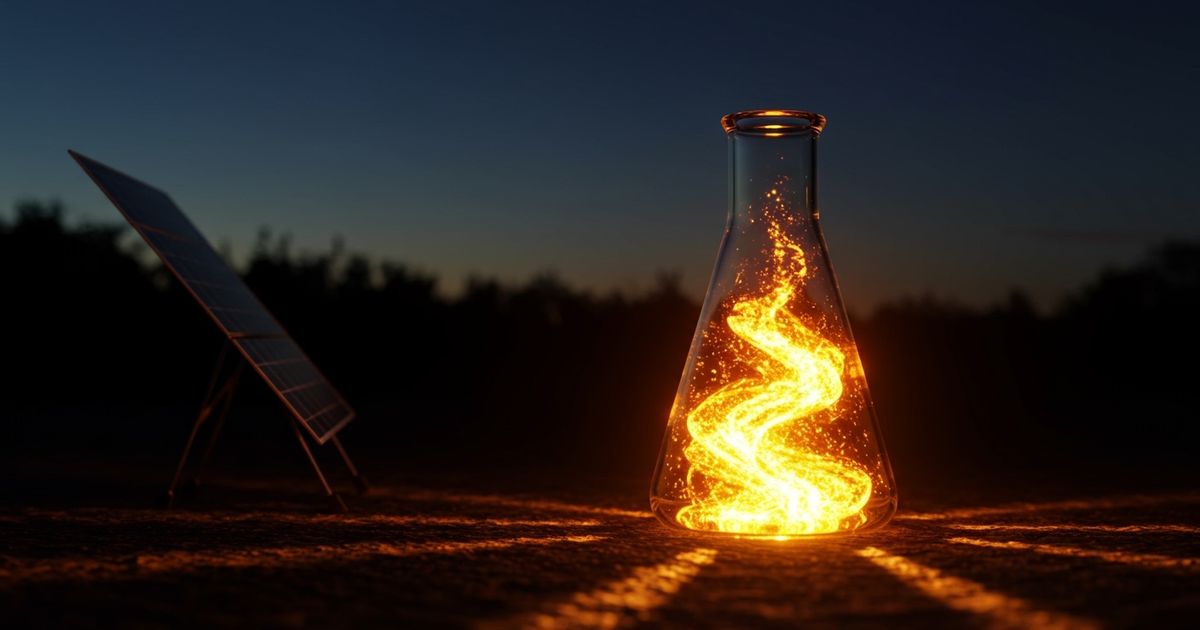
Ever wonder what happens to all that beautiful sunshine after the sun goes down? For all its power, solar energy has a big catch: it only works when the sun is shining. This means that to use solar power at night or on cloudy days, we usually need massive, clunky battery banks or a connection to the electrical grid.
But what if you could actually bottle that sunlight, holding its energy safely inside a material until you need it later? Scientists at UC Santa Barbara have just achieved something truly remarkable, creating a new kind of “liquid battery” that does exactly that. They’ve found a way to store the sun’s energy directly within tiny molecules, releasing it as heat on command — even years after it was first captured.
Background
Right now, most solar energy systems rely on solar panels to convert sunlight into electricity. This electricity can then power your home directly or be stored in large, heavy lithium-ion batteries, similar to the ones in your phone, but on a much bigger scale. While fantastic, these systems have limitations. Batteries are expensive, they degrade over time, and they’re often bulky. Plus, relying on the electrical grid means you’re still connected to a larger energy network, which might not always be ideal, especially in remote areas or during power outages.
The goal has long been to find a way to store solar energy more efficiently, more compactly, and without needing a separate, complicated battery system. Imagine if the very material absorbing the sunlight could also hold that energy. This isn’t a completely new idea; nature does something similar with photosynthesis, where plants capture sunlight and store it as chemical energy. Scientists also took inspiration from everyday items like photochromic sunglasses, which darken in the sun and lighten indoors. This reversible change, triggered by light, hints at how materials can store and release energy.
Bottling the Sun: The Discovery
The team at UC Santa Barbara has designed a special molecule that acts like a tiny, rechargeable solar energy trap. Think of it like this: when sunlight hits these molecules, they don’t just get warm; they actually change their fundamental shape. Imagine a toy car with a spring inside. When you push the car backward, you wind up the spring, storing energy. Release it, and the car zips forward as the spring unwinds.
In this liquid battery, the molecules have a specific structure, a bit like a tiny, intricate puzzle. When exposed to ultraviolet (UV) light, which is a powerful part of sunlight, these molecules absorb the energy. This absorption causes them to rearrange their atoms and contort into a new, more energetic shape. Basically, the light energy is used to force the molecule into an “uncomfortable” position. This new, strained shape holds onto that absorbed energy, much like a stretched rubber band or a wound-up spring.
The amazing part? Once the molecules have changed shape, they can hold onto that stored energy for incredibly long periods — potentially years. And they don’t just let it go randomly. To release the energy, you need to provide a specific trigger, like a tiny bit of heat or a special chemical catalyst. When that trigger is applied, the molecules snap back to their original, relaxed shape, releasing all that stored energy as heat.
In other words, they’ve created a liquid material that can soak up sunlight, keep it “bottled up” for a long time, and then release it as clean, on-demand heat whenever it’s needed. What’s even more impressive is how much energy this material can pack in. The researchers found it stores more energy per kilogram than even advanced lithium-ion batteries. Think of it like being able to store the same amount of power in a smaller, lighter package.
Why This Matters: A Sunny Future
This breakthrough could change the game for how we use solar energy. Currently, the biggest challenge with solar is its intermittency – the sun isn’t always out. This “liquid battery” tackles that head-on. Imagine a future where homes are heated simply by circulating this liquid, pre-charged with sunlight, through a system whenever you need warmth. You wouldn’t need to burn fossil fuels or even draw power from the grid for heating.
This technology could be a game-changer for off-grid communities, making clean, sustainable heating accessible without complex infrastructure. It could also find applications in portable devices that need a consistent heat source, or even industrial processes that require heat on demand. Because the energy is stored as heat rather than electricity, it opens up a whole new range of possibilities for direct thermal applications. Plus, since the material itself is storing the energy, it eliminates the need for bulky, separate battery packs, potentially reducing costs and environmental impact.
What’s Next?
While this discovery is incredibly exciting, it’s still in its early stages. Scientists will now focus on improving the efficiency of the energy storage and release process. They’ll also be exploring different molecular designs to find ones that can store even more energy or release it at higher temperatures. Think of it like optimizing the “spring” in our toy car analogy – making it store more energy or release it more powerfully.
The ultimate vision is a future where “bottled sunlight” becomes a common reality. Imagine a world where entire buildings could be heated simply by circulating a special liquid that absorbed the summer sun, or where a portable device could provide warmth for days, drawing on energy captured weeks before. This research takes us a big step closer to a truly sustainable energy future, where we can harness the sun’s power, not just when it shines, but whenever we choose.