What if flying a helicopter on another planet was less like soaring through the sky and more like trying to swim through invisible molasses? On Mars, the air is incredibly thin. It’s like trying to get lift when there’s almost nothing to push against!
Background
For decades, exploring Mars meant using rovers that trundled slowly across its rocky surface. They were amazing, but they were also limited to what they could drive over. Think of it like exploring a vast landscape only by foot – you miss out on so much. Scientists dreamed of a way to get a bird’s-eye view, to reach places rovers couldn’t, like the tops of steep cliffs or the deep floors of craters.
That dream started to come true with NASA’s Ingenuity helicopter. Attached to the Perseverance rover, Ingenuity was a tiny, experimental craft. It was essentially a tech demo, proving that powered flight was even possible in Mars’s super-thin atmosphere. To give you an idea of how thin it is, Mars’s atmosphere is only about 1% as dense as Earth’s. Imagine trying to make a paper airplane fly effectively in a near-vacuum; that’s the challenge. Ingenuity pulled it off by having very large blades for its size and spinning them incredibly fast. It flew 72 times, far exceeding its original five-flight plan, and completely revolutionized how we think about exploring other worlds.
But Ingenuity was just the beginning. To truly unlock the potential of aerial exploration on Mars, future helicopters need to be bigger, fly higher, cover more distance, and carry more scientific instruments. This means they need even more powerful rotor blades. And that brings us to a huge engineering hurdle: the speed of sound.
Discovery
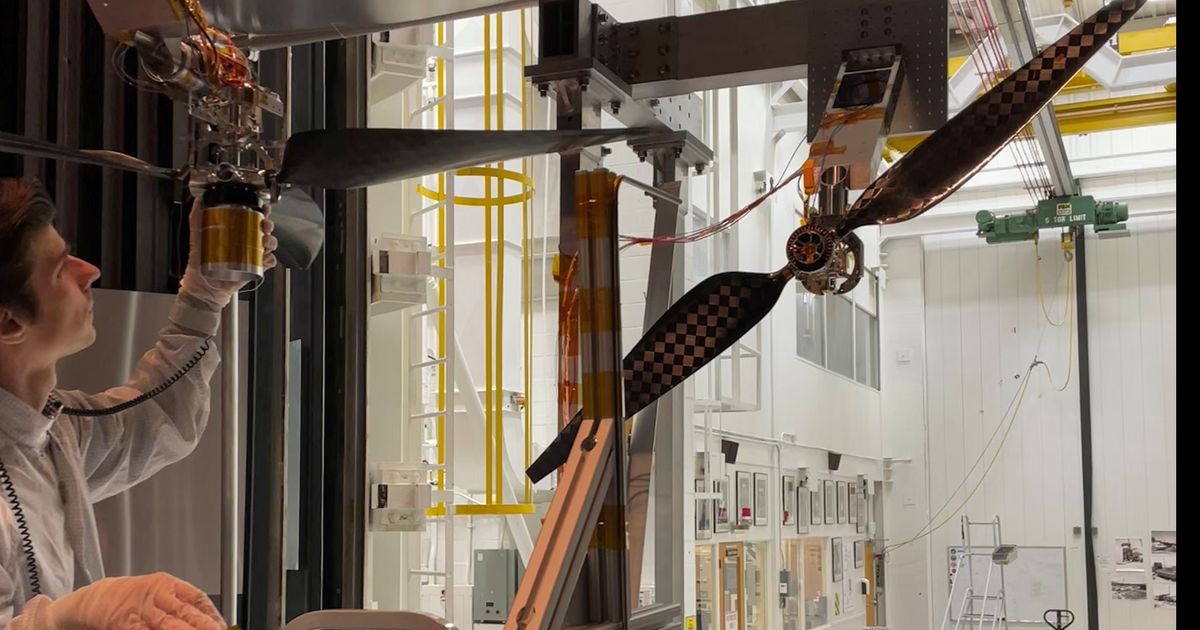
Engineers at NASA’s Jet Propulsion Laboratory (JPL) in Southern California have just made a groundbreaking leap. They’ve been testing new, next-generation helicopter rotor blades designed for future Mars missions. And here’s the mind-blowing part: these blades broke the sound barrier, right inside a special chamber that perfectly mimics Martian conditions.
Let’s unpack that. What is the sound barrier? Imagine a boat speeding through water. It pushes water aside, creating waves that spread out. If the boat goes fast enough, it catches up to its own waves, piling them up at the front, creating a big “bow wave.” The same thing happens with air. Sound travels through air as pressure waves. When something, like an aircraft or the tip of a helicopter blade, moves faster than these sound waves, it creates a massive pressure wave that we hear as a “sonic boom.” Think of the crack of a whip – that’s a mini sonic boom! We call this speed “Mach 1.”
For a helicopter, hitting Mach 1 is usually a big no-no. When a rotor blade tip goes supersonic, it creates huge amounts of drag, causes immense turbulence, and can even damage the blade. It makes the helicopter unstable and inefficient. So, helicopter designers usually try to keep their blade tips well below the speed of sound.
But Mars is different. Because the air is so incredibly thin, a helicopter needs to spin its blades much, much faster to get enough lift. Think of it like trying to scull water with your hands. If the water is thin and watery, you have to move your hands much faster to get the same push as you would in thick, syrupy water. To get those big, next-gen Mars helicopters off the ground, their blade tips have no choice but to push past the sound barrier.
So, NASA engineers designed special blades and put them into a vacuum chamber that’s been pumped down to Mars-like pressure and temperature. Then, they spun them. And spun them. Until the tips of those blades were literally moving faster than the speed of sound in that thin Martian “air.” This is an engineering triumph! It means they’ve found a way to design blades that can survive and even operate efficiently when they’re intentionally breaking the sound barrier, which is something largely avoided on Earth. It’s like building a race car specifically designed to go so fast it routinely drives through invisible walls.
Significance
This isn’t just a cool physics experiment; it’s a game-changer for how we’ll explore Mars. The success of these tests means future Martian helicopters won’t be confined to just short, low flights. They can be designed to:
- Fly higher: Reaching areas that are currently impossible to access, like the upper slopes of massive volcanoes or the rims of vast canyons.
- Go farther: Covering vast distances, perhaps scouting ahead for human missions or mapping huge swathes of the planet.
- Carry more: Equipping them with more advanced scientific instruments, allowing for more complex experiments, or even carrying small samples for return to Earth.
- Assist human missions: Imagine astronauts on Mars having a fleet of drone-like helicopters to scout landing sites, carry tools, or provide aerial support.
Basically, this discovery moves Mars helicopters from being experimental curiosities to becoming indispensable tools for future exploration. They transform our ability to see, understand, and eventually live on the Red Planet.
Outlook
With these super-speedy blades, the sky’s the limit – literally! We could see helicopters that are much larger than Ingenuity, perhaps multi-rotor designs, lifting heavier payloads. Imagine a future mission where a helicopter is deployed to fly into the depths of a Martian cave, exploring environments shielded from radiation and potentially harboring ancient microbial life. Or a “Mars Sample Fetch” helicopter, collecting samples dropped by a rover and bringing them to a launch vehicle for return to Earth.
The challenges aren’t entirely over. Engineers will still need to refine designs for long-term durability in the harsh Martian environment, develop advanced autonomous navigation systems, and figure out how to handle the sheer amount of data these sophisticated machines will generate.
But one thing is clear: by pushing past the sound barrier, these new rotor blades are not just breaking records; they’re opening up a whole new dimension of exploration on Mars. Soon, the Red Planet might just be buzzing with flying machines, charting new paths and uncovering its deepest secrets.