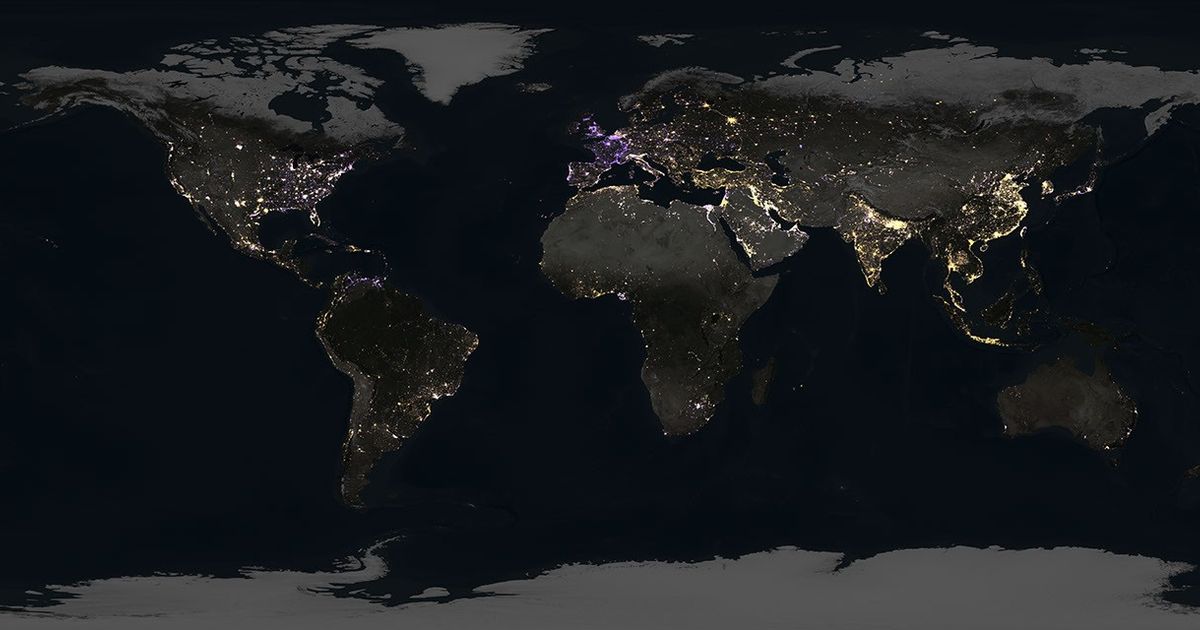
The Earth Has a Glow Problem — And It’s Telling Us Everything
Imagine you could hover in space and watch the entire planet like a city seen from an airplane at night. You’d see glittering webs of light tracing coastlines and highways. But here’s the twist: those lights aren’t just pretty. They’re data. And according to new NASA research, they’ve been changing in ways that are completely rewriting what we thought we knew about energy on Earth.
Why Scientists Care About Light From Space
NASA satellites have been photographing Earth at night for decades. Think of it like taking a timelapse photo of a city every night for years — eventually, you’d notice patterns. Which neighborhoods got brighter? Which went dark? When did things change?
That’s essentially what researchers are doing, but at a planetary scale.
The tool they use is called the Black Marble dataset — a collection of nighttime satellite images that gets scrubbed clean of things like moonlight, clouds, and seasonal changes. What’s left is a remarkably pure picture of human-made light. In other words, everywhere people are burning energy to make light, NASA can see it from orbit.
For years, scientists assumed that nighttime light was a pretty reliable stand-in for economic activity. More light roughly equals more wealth, more industry, more people. Simple enough.
But the new findings are throwing cold water on that assumption. The relationship between light and human activity turns out to be far messier — and far more interesting — than anyone expected.
What the New Maps Actually Show
Here’s where things get really surprising.
Over the last decade, the United States has seen a dramatic surge in artificial light over specific patches of land — not cities, not suburbs, but oil and gas fields. Places like the Permian Basin in Texas and New Mexico, and the Bakken Formation up in North Dakota, lit up like small cities practically overnight.
But why would an oil field glow?
The answer is something called flaring — basically, burning off excess natural gas that can’t be captured or sold. Think of it like this: imagine you’re making orange juice, but you’ve squeezed way more juice than your bottles can hold. Instead of storing it, you just… pour it down the drain. Flaring is the energy industry’s version of that, except instead of juice going to waste, it’s natural gas being burned off into the atmosphere as a giant open flame.
That flame? Bright enough to see from space.
The new NASA maps show just how intense this flaring has been in the U.S. over the past decade, during the boom in a drilling technique called fracking — a method of blasting apart underground rock to release oil and gas. As fracking spread, so did the waste flames lighting up the American night sky.
Basically, satellites were watching the U.S. energy boom from 250 miles up, and nobody fully realized what they were seeing until now.
The World Is Dimming and Brightening at the Same Time
Meanwhile, zoom out to the rest of the world, and you get an even more complex picture.
In parts of South Asia, Southeast Asia, and sub-Saharan Africa, lights are getting brighter — and this time, it’s a good news story. Rural electrification programs are finally connecting villages and communities that have never had reliable electricity before. For the first time, families who used to rely on kerosene lamps or candles are flipping a switch and getting electric light. From space, entire regions are literally waking up.
Think of it like watching a stadium slowly fill up as the lights come on section by section.
But in other parts of the world, the opposite is happening. Some regions are going dimmer, and not always for reasons you’d expect.
Energy conservation efforts — things like switching to more efficient LED streetlights or dimming public lights during off-hours — are making some cities and towns less visible from space, even as their economies grow. This is the part that really breaks the old assumption. A city can be getting wealthier and more developed while actually reducing its light output. It’s like getting better gas mileage: you’re going just as far, using less fuel.
Then there are darker reasons for dimming. Conflict zones, economic crises, and political instability can cause entire regions to go dark. Wars that cut off electricity. Sanctions that limit fuel supplies. Economic collapses that leave people unable to pay their energy bills. The satellite data captures all of it — a kind of silent, heartbreaking record of human suffering written in missing light.
Why This Changes Everything
Here’s the big-picture takeaway: nighttime light data is no longer just a simple scoreboard for economic activity. It’s become something much richer and more complicated.
Scientists are now realizing they need to interpret the light, not just measure it. Bright doesn’t always mean prosperous. Dark doesn’t always mean poor. The same glow might mean a booming oil field in Texas, a newly electrified village in Kenya, or a factory burning waste gas in Siberia.
That distinction matters enormously — especially as the world tries to track its progress on climate goals and energy access.
For policymakers trying to figure out where energy poverty still exists, these maps can be a game-changer. Instead of waiting years for economic surveys to come in, you can look at last night’s satellite data. Lights just came on in a remote region? Maybe an electrification project is working. A cluster of industrial flames still burning? Maybe flaring regulations need to be tightened.
In other words, the night sky has become a dashboard for the global energy transition — updated nightly, visible from space.
What Comes Next
The researchers behind this work are pushing hard to make the data even more precise. Future satellites could potentially detect not just whether lights are on, but what kind of light it is. Different light sources — gas flares, LED streetlights, sodium lamps — have different colors and spectral signatures. Think of it like how a chef can tell the difference between butter browning and burning just by the color of the smoke.
With that kind of precision, scientists could potentially separate flaring from urban growth, track the spread of solar-powered lighting in off-grid communities, or even monitor industrial activity in areas where governments don’t share data.
There’s also a deeper philosophical question lurking here. As the world shifts toward cleaner energy — solar panels, wind turbines, more efficient everything — will the Earth actually get darker at night? And if it does, what does that silence in the satellite images tell us?
Maybe someday, the best sign of a thriving, energy-efficient civilization will be a world that’s learned to glow a little less. And satellites will be watching, every single night, to see if we get there.