Curiosity Finds Life’s Ingredients on Mars: A Cosmic Treasure Hunt!
Imagine digging in a very old, dusty backyard and unearthing not just dirt, but ancient blueprints for life itself. That’s a bit like what NASA’s Curiosity rover just did on Mars! It found a surprising array of carbon-based molecules — the very building blocks that life on Earth relies on.
Why We’re So Obsessed with the Red Planet
For decades, humanity has gazed at Mars and wondered: is anyone home? Or, more realistically, was anyone ever home? To answer that, we need to know if Mars ever had the right conditions for life to begin. That’s where missions like the Curiosity rover come in. Launched back in 2011, this plucky, car-sized robot has been trundling across the Martian surface, specifically exploring an area called Gale Crater.
Why Gale Crater? Because scientists believe it was once a giant lake. Think of it: a vast body of water, perhaps billions of years ago, offering a cozy home for any potential tiny microbes. Curiosity’s main job is to act like a robotic geologist and chemist, sniffing out clues about Mars’s past climate and looking for signs of habitability — basically, finding places where life could have survived. It drills into rocks, scoops up soil, and then cooks these samples in its internal lab, trying to identify what they’re made of. It’s like a very fancy, very remote detective agency searching for cosmic fingerprints.
Unearthing Ancient Organic Secrets
And what fingerprints it found! Curiosity has detected a whole smorgasbord of what scientists call “organic molecules.” Now, “organic” might make you think of kale or free-range chickens, but in science, it just means molecules that contain carbon atoms, usually bonded with hydrogen. These aren’t necessarily signs of life, because organic molecules can form through non-biological processes too. But here’s the crucial part: every single living thing we know of, from the smallest bacterium to the largest blue whale, is built from these carbon-based compounds. They are the essential LEGO bricks of life.
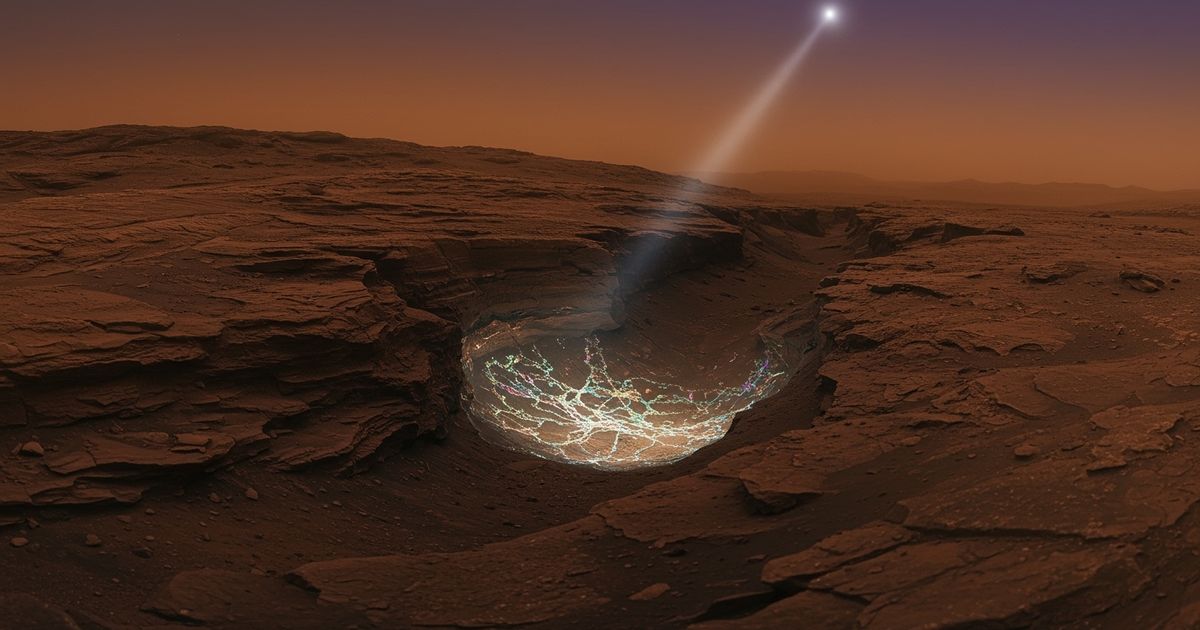
The rover found these precious molecules hidden deep within ancient, clay-rich rocks. Think of these rocks as time capsules. Billions of years ago, when Gale Crater was a lake, tiny bits of carbon-based material might have settled to the bottom. Over time, they got buried under layers of sediment, which eventually turned into rock. The clay acted like a super-protective wrapper, shielding these delicate molecules from the harsh Martian environment, which is constantly bombarded by radiation that can shred organic compounds. It’s like finding a perfectly preserved sandwich from thousands of years ago, still intact inside its lunchbox.
Even more exciting, some of the molecules Curiosity identified bear a striking resemblance to the fundamental building blocks of DNA. Imagine finding not just scattered LEGOs, but some pieces that look exactly like the ones you’d use to build a tiny ladder or a spiral staircase – structures essential for life’s genetic code. This isn’t actual Martian DNA, to be clear. But it suggests that the ingredients needed to form such complex structures were present on Mars way back when.
This discovery is a big deal because it confirms that not only did Mars once have liquid water — a key ingredient for life — but it also had the fundamental carbon compounds, and they were preserved for billions of years. This means Mars wasn’t just a wet rock; it was a rock with potential.
Shifting Our View of Martian History
This changes our understanding of Mars in a profound way. For a long time, Mars was often thought of as a cold, desolate desert, maybe with some ice at the poles. But Curiosity’s findings paint a much richer, more vibrant picture of ancient Mars. It suggests that, billions of years ago, the Red Planet might have been a much more inviting place, bubbling with the right chemistry to potentially spark life. We now know that the critical components — water, energy (from the sun or chemical reactions), and organic molecules — were all available on early Mars.
In other words, while this isn’t proof of Martian microbes wiggling around in ancient lakes, it’s the strongest evidence yet that Mars could have been biologically promising. It moves the needle from “maybe” to “wow, this looks really good!” for the possibility of past life.
What’s Next in the Cosmic Story?
So, what happens now? This discovery fuels the fire for future missions. Scientists are already planning how to retrieve samples from Mars and bring them back to Earth. Imagine being able to study these ancient Martian rocks in our labs, with the most powerful microscopes and analysis tools available! That could be the ultimate way to look for definitive signs of past life, perhaps even microscopic fossils or subtle chemical signatures that are too tiny for a rover to detect on its own.
This finding also makes us wonder: if life didn’t start on Mars, why not? And if it did, could traces still be hidden deep underground, protected from the harsh surface radiation? The search for life beyond Earth is one of humanity’s greatest adventures. With each discovery from rovers like Curiosity, we piece together more of the cosmic puzzle, bringing us closer to answering that profound question: Are we alone in the universe? The Red Planet continues to whisper its ancient secrets, and we’re finally starting to listen.