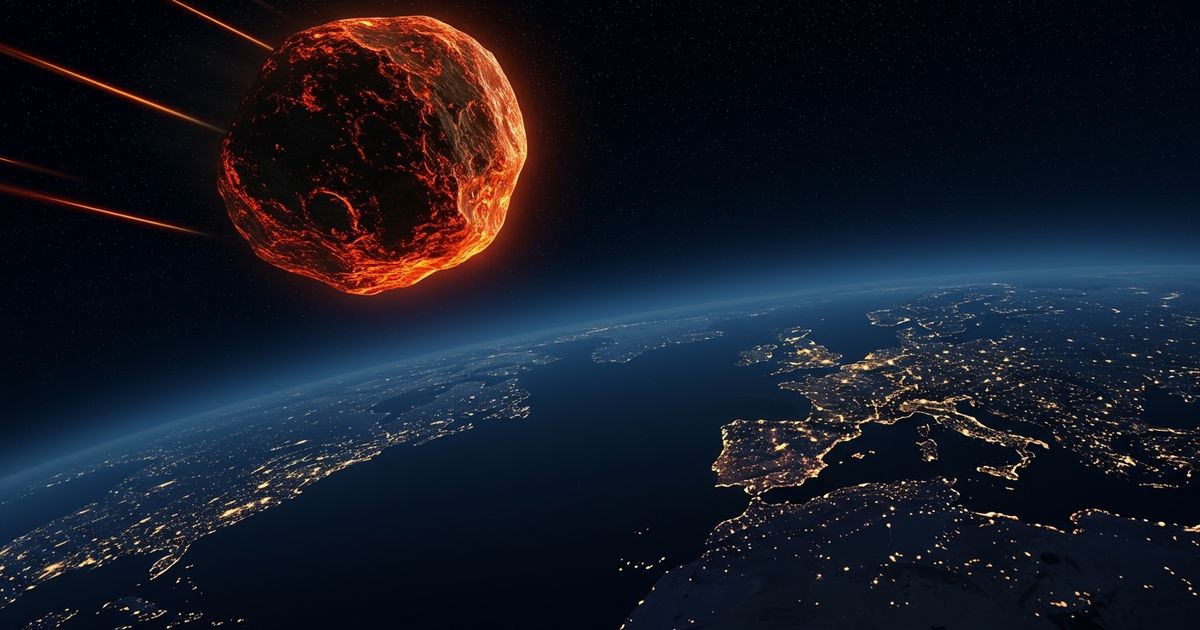
A Rock the Size of the Eiffel Tower Is About to Fly Past Your Backyard
On Friday, April 13, 2029 — yes, a Friday the 13th — a mountain-sized space rock is going to skim past Earth so close that you’ll be able to see it with your naked eye. No telescope required. Just look up.
This isn’t science fiction. It’s one of the most anticipated astronomical events in human history, and it’s coming whether we’re ready or not.
What Even Is Apophis?
Meet Apophis — nicknamed the “God of Chaos” after the ancient Egyptian deity of destruction. It’s an asteroid, which is basically a leftover chunk of rock from when our solar system was still being built, about 4.5 billion years ago. Think of asteroids like the crumbs left on a table after someone assembles a giant cosmic puzzle. Most of them hang out in a belt between Mars and Jupiter, minding their own business.
Apophis is not one of those well-behaved crumbs.
This particular rock is roughly 340 meters across — about the height of the Eiffel Tower, or three football fields laid end to end. It weighs somewhere in the neighborhood of 60 million tons. And for a while, scientists were genuinely worried it might hit us.
When Apophis was first discovered in 2004, early calculations suggested there was up to a 2.7% chance of impact in 2029. That doesn’t sound like much, but in asteroid terms? That’s terrifying. Imagine flipping a coin and knowing there’s a 1-in-37 chance the outcome destroys a city. People noticed.
Thankfully, better measurements eventually ruled out any impact — not just in 2029, but for at least the next 100 years. You can breathe now.
So What’s Actually Going to Happen?
Here’s where things get genuinely extraordinary.
On April 13, 2029, Apophis will pass within about 32,000 kilometers of Earth’s surface. That sounds like a lot until you realize that many of our weather and communications satellites orbit at around 36,000 kilometers. In other words, this asteroid will fly below the ring of satellites we use for GPS and TV broadcasts.
Think of it like this: if Earth were a basketball, Apophis would sail past at roughly the distance of your fingertips when you hold the ball at arm’s length. Cosmically speaking, that is an absolute razor’s edge.
And the best part? You’ll be able to see it happening in real time.
For skywatchers across Europe and Africa, Apophis will be visible to the naked eye — no binoculars, no telescope, no special equipment. It will appear as a bright, steadily moving dot of light crawling across the night sky, crossing the width of a full moon every minute. Scientists estimate it will get about as bright as the stars in the Little Dipper, which is easily visible on a clear night away from city lights.
It won’t look like a fireball screaming across the sky. It’ll be more subtle than that — a quiet, purposeful light sliding through the stars. But knowing what that light is, and how close it actually is, makes it one of the most spine-tingling things a human being can witness.
The entire visible pass will last several hours. Apophis will be visible first from the eastern United States late at night, then sweep across the Atlantic, becoming best placed for viewing over Western Europe and Africa as the night progresses. For those in the prime viewing zone, this is the kind of thing people will talk about for the rest of their lives.
Why Scientists Are Losing Their Minds Over This
Astronomers have been waiting for this moment for decades — and not just for the spectacle.
Close flybys like this are incredibly rare scientific goldmines. Normally, studying an asteroid means launching a billion-dollar spacecraft and waiting years for it to arrive. In 2029, the asteroid is coming to us. Multiple space agencies, including NASA and the European Space Agency (ESA), are already planning dedicated observation campaigns. Some are even considering sending a spacecraft to rendezvous with Apophis during the flyby.
Here’s what scientists hope to learn. As Apophis skims past Earth, our planet’s gravity will actually squeeze and pull the asteroid. Basically, imagine slowly squishing a stress ball — the pressure changes how it’s shaped internally. This gravitational kneading could cause small shifts in Apophis’s surface, maybe even trigger tiny rockslides. Watching those changes in real time will tell us an enormous amount about what the asteroid is made of and how it’s held together on the inside.
That matters for a very practical reason. If we ever discover an asteroid actually on a collision course with Earth, we need to know how to deflect it. Do you blow it up? Push it? The answer depends entirely on whether the asteroid is a solid chunk of rock or more like a loose pile of gravel held together by gravity. Think of the difference between redirecting a bowling ball versus a bag of sand — very different problems. Apophis could help us figure out which category dangerous asteroids fall into.
A Once-in-a-Lifetime Doesn’t Mean Once-in-a-Lifetime for Everyone
Here’s the honest truth about “once-in-a-lifetime” events: they tend to reward preparation.
The best views will be from specific parts of the world, at specific times of night. Clouds could ruin everything. Light pollution from cities will wash out the view. If you’re serious about witnessing this, now — years in advance — is the time to start planning.
Astronomy travel companies are already organizing tours to prime viewing locations in Europe and Africa. Observatories will host public events. Dark-sky parks and rural areas away from city lights will fill up with stargazers carrying lawn chairs and thermoses of coffee.
If you can’t travel, major online observatories will almost certainly stream the event live. It won’t be quite the same as standing under an open sky and watching a mountain-sized rock sail past with your own eyes, but it’s far better than missing it entirely.
What Comes After the “God of Chaos”?
After 2029, Apophis will swing back around. Scientists predict it will make additional close approaches to Earth in the decades that follow, though none anywhere near as dramatic as 2029.
But the bigger picture here is what Apophis represents for humanity’s relationship with space. We live on a planet that exists inside a cosmic shooting gallery. Rocks of all sizes drift through our solar system, and occasionally their paths intersect with ours. Most are tiny and burn up harmlessly in our atmosphere — those are the shooting stars you see on a clear night. But larger ones are out there.
The good news is that for the first time in human history, we actually have the tools to find these rocks before they find us, track them precisely, and — if the early results of NASA’s DART mission are any guide — potentially nudge them out of the way. In 2022, NASA deliberately crashed a spacecraft into a small asteroid and successfully changed its orbit. It worked. Humanity deflected an asteroid.
Apophis, then, isn’t just a rock flying past. It’s a reminder that the universe is dynamic, surprising, and occasionally pointed directly at us. It’s also a chance to look up, collectively, as a species — and feel the peculiar thrill of watching something ancient and enormous sail harmlessly by, close enough to almost touch.
Mark your calendar. April 13, 2029. Find a dark field. Bring a blanket.
The God of Chaos is coming to say hello.