When One Typo Rewrites the Blueprint for Sex
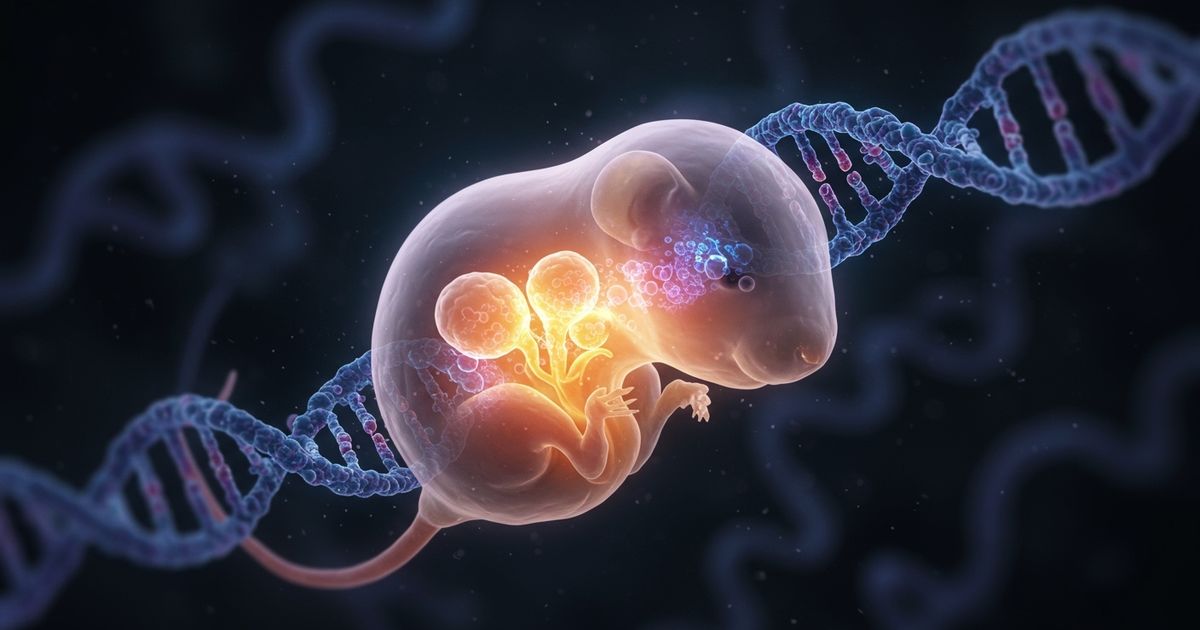
Imagine editing a single word in a 3-billion-letter instruction manual — and completely changing what gets built. That’s essentially what scientists just did with mice. By tweaking one tiny spot in a female mouse’s DNA, her body grew testes instead of ovaries. The implications for how we understand biological sex are enormous.
The Instruction Manual Has Fine Print
To understand why this is a big deal, you need to know a little about how DNA works.
Think of your DNA as a massive recipe book. Some pages contain actual recipes — the instructions for building proteins, the tiny molecular machines that do almost everything in your body. These are called genes.
But here’s the twist: most of your DNA isn’t recipes. It’s more like the sticky notes, margin scribbles, and bookmarks between the recipes. Scientists used to think this stuff was basically useless filler — they even called it “junk DNA.” We now know that was very wrong.
This so-called “junk” is actually full of regulatory regions — control switches that tell your genes when to turn on, how loud to turn on, and for how long. In other words, the recipes matter, but so does the chef reading them.
The Switch That Decides Everything
Now, how does a developing embryo “decide” whether to become biologically male or female?
It all comes down to a master gene called SRY — but only in males. Think of SRY like a foreman who shows up on a construction site and shouts, “We’re building a factory!” (in this case, testes). Without that foreman, the default plan kicks in and the site becomes something different — ovaries.
But there’s a second key player: a gene called SOX9. This one is critical for actually constructing the testes once the foreman gives the order. SRY essentially goes to the control panel and cranks SOX9 up to full volume in male embryos.
Here’s where it gets interesting. SOX9 doesn’t just flip on by itself. It needs someone to find it in that giant recipe book and turn the page to the right spot. That’s where the regulatory switches come in — the “fine print” of the genome.
The Tiny Tweak That Changed Everything
Scientists already knew about a regulatory region near SOX9 called XYSR — a switch that, when activated, turns SOX9 on and helps testes develop. In males, XYSR gets flipped on. In females, it stays off.
But in a new study, researchers went looking for why it stays off in females. And they found it: a single short stretch of DNA — a kind of molecular “do not enter” sign — sitting right in the middle of XYSR. In females, a protein latches onto this spot and essentially blocks the switch from being flipped.
Here’s the wild part. When researchers deleted just that one small blocking sequence from female mice — not a gene, just a tiny piece of the regulatory fine print — the females developed testes.
Let that sink in. One small edit to the fine print. Not to a recipe, just to a sticky note. And the entire outcome flipped.
Think of it like a traffic signal. The gene is the road. The regulatory region is the traffic light. Scientists didn’t build a new road or tear one down — they just removed a single red light, and suddenly traffic started flowing in a completely different direction.
Why This Changes How We Think About Sex
For decades, scientists focused on genes — the actual coded recipes — when trying to understand biological sex. If something went wrong with sex development, researchers looked for mutations in genes like SRY or SOX9.
But this discovery suggests we’ve been reading the wrong pages.
The real story might be hiding in the margins. Variations in these non-coding regulatory regions — the fine print — could explain many cases where sex development doesn’t follow the expected path. Conditions like differences of sex development (DSDs) affect roughly 1 in 100 people to some degree, and in many cases, doctors can’t find any mutation in known genes. This research suggests the answer might be sitting in the parts of the genome we’ve been overlooking.
Basically, we’ve been inspecting the light bulbs when the problem was always in the wiring behind the wall.
This also deepens our understanding of biological sex itself. Sex isn’t just a simple on/off switch controlled by one gene. It’s a finely tuned system with layers of control, checks, and balances — and a surprising amount of that control lives in DNA we almost threw away as “junk.”
The Bigger Picture: Junk No More
This finding is part of a growing revolution in genetics. For years, the Human Genome Project — the effort to map all human DNA — was celebrated mostly for decoding our genes, which make up only about 2% of our total DNA. The other 98%? Mostly ignored.
Now, scientists are realizing that the 98% might be just as important as the 2%. It’s the operating system behind the software. Change the software, sure, you get noticeable effects. But mess with the operating system, and the whole computer behaves differently.
That’s what happened here. No gene was changed. Just the operating system — and everything shifted.
What Comes Next?
Researchers will now look for similar regulatory switches elsewhere in the genome — other tiny fine-print elements that might be quietly controlling huge biological outcomes. The question of what else is hiding in that 98% is suddenly very exciting.
For medicine, this could eventually lead to better diagnosis for people with unexplained differences in sex development. It might also open new doors in fertility research, reproductive medicine, and our broader understanding of how genes get turned on and off throughout life.
And philosophically? This research nudges us to think of biological sex not as a single lever, but as a dimmer switch with dozens of invisible hands on it — each one a tiny piece of DNA that science is only just learning to see.
The fine print, it turns out, was never junk. We just hadn’t learned to read it yet.