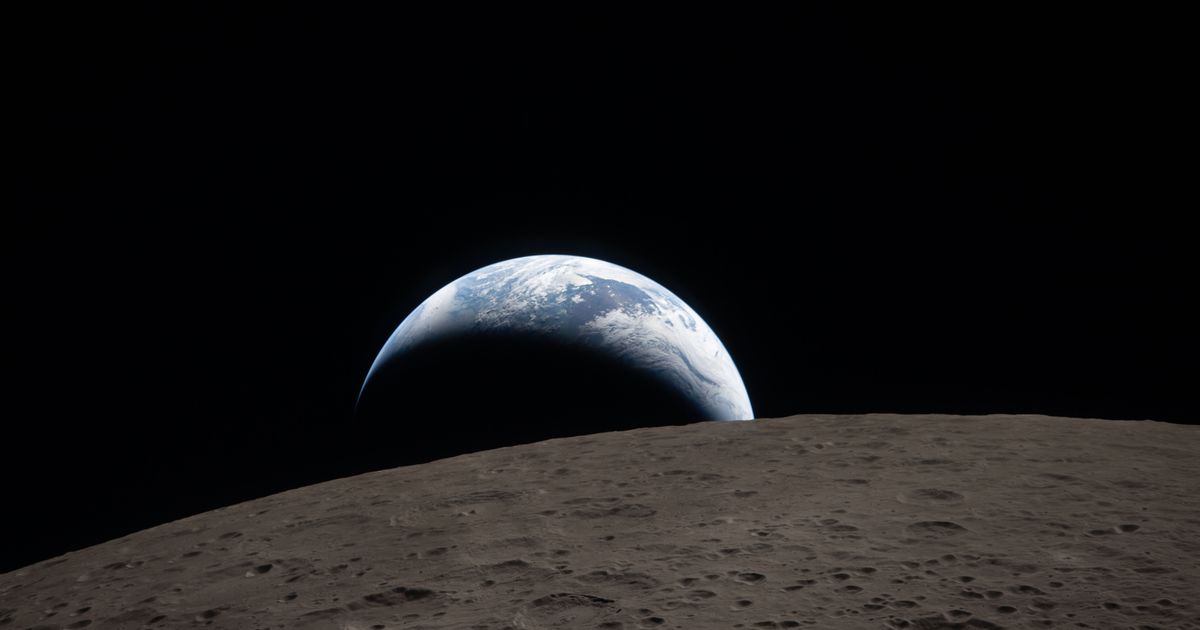
Someone Took a Photo of Earth “Setting” — And It Might Break Your Brain
You’ve watched the sun set hundreds of times. Maybe the moon, too. But have you ever seen Earth set? On April 6, 2026, four astronauts aboard NASA’s Artemis II mission did exactly that — and they had a camera ready.
Why This Moment Even Exists
To understand what’s happening in this photo, we need to take a step back — way back.
Most of us grow up thinking of the Moon as something we look at. It hangs in our sky, goes through its phases, and occasionally gets in the way of the Sun during an eclipse. But here’s the thing: the Moon is a place. A real, physical world with a surface you could stand on. And if you were standing there, you’d be the one looking up at something else.
That something else would be Earth.
The Artemis II mission is NASA’s first crewed trip to the Moon since the Apollo era — the last time humans walked on the lunar surface was 1972. Artemis II doesn’t land; instead, the crew flies around the Moon in a loop, testing the spacecraft and systems that will eventually carry astronauts back down to the surface. Think of it like a test drive around the block before committing to a cross-country road trip.
During that loop, the crew swings around to the far side of the Moon — the side that permanently faces away from Earth. It’s a place no human eye saw directly until 1968. And it was on this leg of the journey, coming back around, that the crew caught something extraordinary on camera.
The Photo That Flips Your Perspective
Here’s what makes this image so mind-bending.
When the Artemis II crew flew over the far side of the Moon, Earth completely disappeared from view. The Moon’s bulk was sitting right between them and home. Then, as their spacecraft curved back around, Earth slowly crept back into sight — rising up over the lunar horizon. Except from the crew’s perspective flying in the other direction, it looked like Earth was setting.
Think of it like this. Imagine you’re on a road trip, and you watch the city skyline slowly sink below the hills as you drive away. Same idea — except the “city” is our entire planet, and the “hills” are the Moon’s curved edge.
The resulting photograph shows the cratered, grey lunar surface in the foreground, ancient and silent. And there, just above the horizon, is Earth — a small, vivid marble of blue and white, suspended in the absolute blackness of space.
It’s called an “Earthset.” And it’s as rare as it sounds.
While orbiting the Moon, the crew didn’t just snap photos out the window. They also described what they were seeing below them in real time. The lunar far side is a geologist’s dream — and a haunting one at that. The astronauts recorded impact craters pockmarking the surface like old scars. Some of these craters are billions of years old, formed when space rocks slammed into the early Moon before Earth even had complex life.
They also described ancient lava flows — massive plains of rock that formed when the Moon was still volcanically active, long before it became the quiet, frozen world we see today. And they spotted surface cracks and ridges, wrinkles in the lunar crust that formed as the Moon gradually cooled and shrank over billions of years. Basically, the Moon is like a piece of fruit slowly drying out — and those ridges are the wrinkles.
Why This Actually Matters
You might be thinking: okay, cool photo. But why does this matter?
It matters for a few reasons, and they stack on top of each other beautifully.
First, there’s the pure science. Every piece of data the Artemis II crew collects — every photo, every terrain description, every systems check — feeds directly into the next missions. Artemis III is planned to actually land astronauts on the lunar surface, near the Moon’s south pole, a region scientists believe may hold deposits of water ice hiding in permanently shadowed craters. Water on the Moon isn’t just scientifically fascinating. It’s practically revolutionary. Water can be split into hydrogen and oxygen — rocket fuel. In other words, the Moon could eventually serve as a refueling station for deeper missions into space.
Second, images like this Earthset photo do something that dry data simply can’t. They shift perspective. When the Apollo 8 astronauts took the famous “Earthrise” photo in 1968, it’s widely credited with helping spark the modern environmental movement. Seeing our planet — the whole thing, tiny and fragile and alone — hanging in the dark changed how people thought about it. This new Earthset photo carries that same power. We’re not just inhabitants of a planet. We’re travelers on a rock floating through an enormous, mostly empty universe.
Third, this mission proves the hardware works. Getting humans safely around the Moon and back is genuinely hard. The Orion spacecraft carrying the Artemis II crew had to survive the radiation environment of deep space, a place where Earth’s magnetic field no longer protects you. Every successful moment of this mission is a building block.
What Comes Next
The astronauts are home now, but the work is far from over.
The data, the photographs, and the crew’s firsthand descriptions will be analyzed for months. Scientists will use the terrain observations to refine their maps of the lunar far side. Engineers will pour over every reading the spacecraft produced to fine-tune what comes next.
And what comes next is enormous.
Artemis III aims to put humans on the Moon again — including, for the first time in history, a woman and a person of color. After that, the long-term vision includes a lunar space station called Gateway, orbiting the Moon and serving as a hub for both lunar surface missions and, eventually, crewed missions to Mars.
That’s not science fiction. The pieces are being assembled right now.
But maybe the most exciting thing about this moment is what it does to your imagination. Somewhere out there, there’s a photograph of Earth the size of a marble, taken by humans who were farther from home than almost anyone has ever been. And instead of looking down at the Moon, they looked back.
The next time you watch the sun set, try this: imagine you’re on the Moon, watching Earth do the same thing. Imagine the silence, the ancient grey dust beneath your feet, and our entire world — every ocean, every mountain, every person you’ve ever met — slowly slipping below the horizon.
That’s not just a photo. That’s a new way of being human.