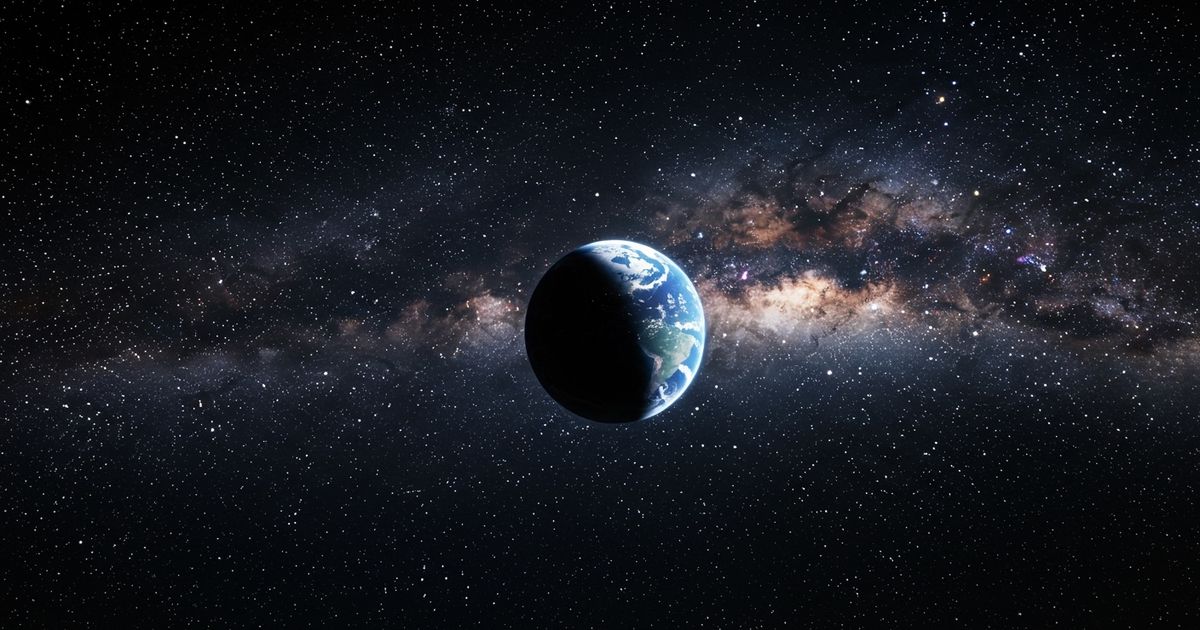
Have you ever looked up at the night sky, dotted with billions of stars, and wondered, “Are we alone?” It’s a question humanity has pondered for ages. Logically, given the sheer size and age of the universe, there should be countless other civilizations out there, right? So, where is everybody?
Background
This cosmic puzzle is known as the Fermi Paradox, named after physicist Enrico Fermi, who famously asked that very question decades ago. If advanced alien civilizations exist, why haven’t we seen any signs of them? This isn’t just about little green men showing up on our lawns. It’s about anything from powerful radio signals to massive structures built around distant stars.
Back in the 1970s and early 80s, two scientists, Michael Hart and Frank Tipler, pushed this idea to a provocative conclusion. Their argument went something like this: imagine an alien civilization just a little bit more advanced than us. Given enough time, they would likely develop incredibly sophisticated technology. Think about self-replicating machines – robots that can build copies of themselves, and those copies can build more copies, like a technological virus spreading through space. These are sometimes called “Von Neumann probes,” named after a brilliant mathematician.
Now, picture these super-advanced robots traveling from star system to star system. Even at speeds much slower than light, if they could build new copies at each stop, they could colonize an entire galaxy in a relatively short amount of cosmic time – perhaps a few million years. That sounds like a long time to us, but for a galaxy that’s billions of years old, it’s just a blink of an eye. Hart and Tipler argued that if such civilizations existed, they would have had plenty of time to colonize our Milky Way galaxy, including Earth, long before humans even evolved. Since there’s absolutely no evidence of alien colonization here on Earth – no ancient alien ruins, no space robots mining our moon – they concluded that advanced extraterrestrial civilizations simply don’t exist. Humanity, in their view, is utterly alone.
Discovery
Fast forward to today, and astronomer David Kipping from Columbia University has taken a fresh look at this age-old question. Instead of just speculating, Kipping used a mathematical approach called Bayesian probability. Think of it like this: Bayesian probability helps you update your beliefs about something based on new evidence. Imagine you’re betting on whether it will rain tomorrow. You start with a general idea, maybe 50/50. Then, you check the weather forecast, which says there’s an 80% chance of rain. You use that new evidence to update your belief, making it much more likely you’ll need an umbrella.
Kipping applied this powerful tool to the Fermi Paradox. Crucially, he took the very argument of Hart and Tipler – the complete lack of evidence for alien visitation on Earth – and treated it as a piece of data. In other words, the fact that no aliens have shown up here isn’t just an observation; it’s a critical clue about how rare advanced life must be.
His findings are fascinating and, depending on your perspective, a little sobering. Kipping’s calculations suggest that the chances of life starting on a habitable planet, like simple microbes, might actually be quite good. So, the universe could be teeming with basic life forms, like bacteria or algae.
However, here’s the catch: the probability of that simple life then evolving into complex, intelligent, and technologically advanced life forms that could build star-faring civilizations is incredibly low. Think of it like a very difficult marathon. It’s relatively easy to start the race, but only a tiny fraction of runners ever make it to the finish line, especially if there are hidden obstacles along the way. Kipping’s work suggests that the “Great Filter” – that ultimate bottleneck preventing life from becoming widespread across the galaxy – isn’t necessarily life beginning itself, nor is it a future catastrophe that will wipe us out. Instead, it’s most likely the immense challenge of simple life evolving into intelligent, space-faring life. It’s a hurdle that very, very few life forms ever clear.
In essence, Kipping’s model supports the idea that intelligent life is extremely rare. Our existence isn’t just a lucky break; it’s an astronomical anomaly, a cosmic lottery win against staggering odds.
Significance
This research fundamentally shifts our understanding of humanity’s place in the universe. If Kipping’s analysis is correct, it means we probably aren’t just one civilization among millions. We might be one of a very select few, possibly even unique, in our entire galaxy.
It provides a strong, mathematically supported argument for why the night sky seems so quiet. It’s not that life can’t begin; it’s that the journey from a single-celled organism to a civilization capable of interstellar travel is extraordinarily difficult, perhaps requiring a chain of unlikely events that rarely, if ever, align.
This perspective imbues our planet and our civilization with an even greater sense of preciousness. If intelligence and technological advancement are truly this rare, then protecting Earth and fostering our own survival becomes an even more profound responsibility. We might not be waiting for aliens to arrive; we might be the exception that proves the rule.
Outlook
So, what does this mean for the future? Does it suggest we should stop listening for alien signals? Not necessarily. While Kipping’s work suggests the odds are stacked against finding advanced life, it doesn’t make it impossible. It simply makes the discovery even more momentous if it ever happens.
This new statistical framework offers a different way to think about the universe and our search for extraterrestrial intelligence. It encourages us to continue searching, but perhaps with a refined understanding of the immense challenges involved in the evolution of complex, intelligent life. Future research might focus on trying to identify more specific “filters” – what exact steps in evolution or planetary development are so incredibly difficult to achieve?
Ultimately, Kipping’s work doesn’t give us a definitive “yes” or “no” answer to the “Are we alone?” question. But it does give us a much stronger hint than before, suggesting that the path to advanced life is paved with countless, nearly insurmountable obstacles. It leaves us with the powerful thought that perhaps, in this vast, ancient cosmos, our noisy, curious civilization on this small blue planet is one of the most extraordinary stories ever told.