A Whale of a Birth Story
Imagine going into labor — and your entire neighborhood shows up to help. Not your family. Not your closest friends. Just… people you know. Neighbors, acquaintances, maybe the person you nod to at the grocery store. That sounds strange for humans. But for sperm whales, it turns out, that’s just Tuesday.
New research published in the journal Science has revealed something remarkable about how sperm whales give birth — and it’s rewriting what we thought we knew about one of the ocean’s most mysterious creatures.
What Makes Sperm Whales So Fascinating (And Hard to Study)
Sperm whales are the largest toothed predators on Earth. Picture an animal as long as a school bus, diving deeper than most submarines, using clicks so powerful they can stun prey. They’re extraordinary by any measure.
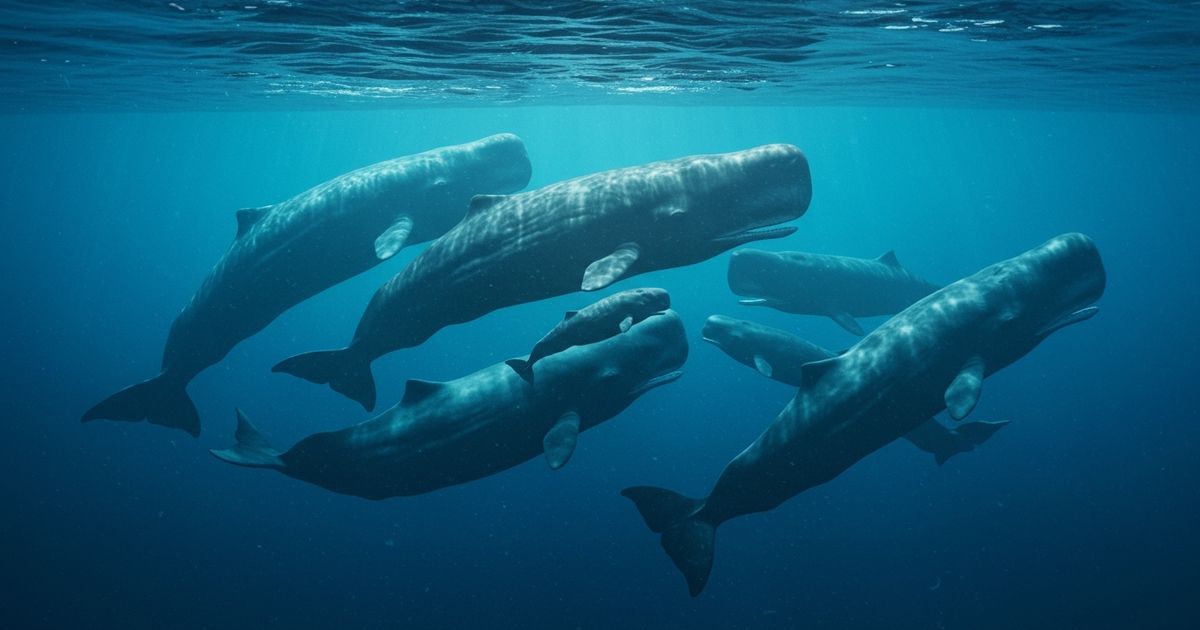
But here’s what’s really interesting: sperm whales are also deeply social. They live in tight-knit groups, they have distinct cultures passed down through generations, and they even babysit each other’s calves. Scientists have long suspected that sperm whale society is surprisingly sophisticated — more like elephants or primates than what most people imagine when they think of a fish (though technically, whales are mammals, of course).
The problem? Studying them is incredibly hard. They spend most of their lives in the deep ocean. Births especially are almost never observed by researchers. For decades, what actually happens when a sperm whale gives birth was largely a mystery.
The Discovery: Birth Is a Team Sport
That’s what makes this new study so remarkable.
Researchers managed to document sperm whale births and, crucially, who shows up to help. What they found was surprising: when a sperm whale goes into labor, other whales gather around to assist — and these helpers are not closely related to the mother.
Think about that for a second. In the animal kingdom, helping behavior — where one individual puts in effort and energy to help another — is usually explained by family ties. You help your sister because you share genes. You help your cousin because you share some genes. This is the classic logic of evolutionary biology, sometimes called “kin selection.” In other words, being nice to relatives is really just a sneaky way of helping copies of your own genes survive.
But sperm whale birth helpers don’t appear to be close relatives of the mother at all. They’re more like… community members. Neighbors. Acquaintances who roll up their sleeves anyway.
This kind of help between non-relatives is called altruism toward non-kin — and it’s genuinely rare in the animal world. Think of it like showing up to help a stranger move apartments. You’re spending your energy, your time, your effort — and getting nothing obvious in return.
Why Would Anyone Do That?
This is the puzzle at the heart of the research.
Scientists have a few ideas. One possibility is reciprocal altruism — basically, “I’ll scratch your back, you scratch mine.” If every female in the group might one day need birth support, it makes sense to build a culture of helping. You help today because you might need help tomorrow. It’s like an unspoken neighborhood agreement.
Another idea is that these whales live in social units — stable groups that spend years, sometimes decades, together. Over that much time, even non-relatives can become deeply interconnected. The survival of the group depends on each new calf making it. So everyone has a stake in a successful birth. Think of it like a sports team: you’re not all family, but you’re invested in each other’s success because you’re playing the same game.
What’s especially striking is that the helpers aren’t passive bystanders. They actively participate — staying close, providing what researchers describe as protective and supportive behaviors around the laboring whale. This is coordinated, purposeful action. Not instinct. Not accident.
Why This Changes the Story
Here’s why scientists are so excited.
For a long time, complex social behavior — the kind that involves cooperation, trust, and long-term relationships — was thought to require close family bonds as a foundation. The idea was: you start by cooperating with family, and eventually that spills over into broader social networks.
Sperm whales seem to flip that script.
Their society is built around matrilineal groups — groups centered on females and their offspring — but these groups include individuals who aren’t necessarily close relatives. Yet they cooperate deeply. They share childcare. They coordinate hunts. And now we know they help each other give birth.
This suggests that the roots of complex society don’t require close genetic ties. Instead, stable long-term relationships — built on shared experience and mutual dependence — might be enough to generate the kind of deep cooperation we usually associate with family.
In other words, it’s not blood that holds these societies together. It’s history.
That’s a profound shift in how evolutionary biologists think about the origins of social complexity. And it puts sperm whales in a very exclusive club — alongside elephants, chimpanzees, and humans — as animals whose societies are structured around something more than just genetics.
What This Means for Us
There’s something quietly moving about this research.
We tend to think of sophisticated social behavior — empathy, cooperation, community — as uniquely human achievements. But sperm whales have been building complex, cooperative societies in the deep ocean for millions of years. They didn’t need language or cities or laws. They just needed each other, and enough time together to build trust.
The discovery also has real implications for conservation. Sperm whales are still recovering from centuries of commercial whaling, which didn’t just reduce their numbers — it shattered their social structures. Entire communities were wiped out. The cultural knowledge and social bonds that made their societies function were lost.
Understanding just how intricate and important those social bonds are — that birth itself is a community event, not a private one — adds urgency to protecting not just individual whales, but their social networks. A lone sperm whale isn’t just an animal. It’s a node in a web of relationships that took decades to build.
What Comes Next
The researchers are clear that there’s still so much to learn.
We still don’t fully understand what the helpers are actually doing during birth. Are they guarding against predators like sharks? Are they helping physically? Are they providing some kind of social reassurance to the mother? Future studies will need to watch these moments more closely — no easy task when your subjects dive to depths that would crush a submarine.
There are also bigger questions about how widespread this behavior is. Do all sperm whale populations do this? Is it learned and cultural, or is it hardwired? Could other whale species show similar patterns we simply haven’t caught on camera yet?
And perhaps most tantalizing: if long-term stable relationships — not family ties — are the real engine of social complexity in sperm whales, what does that tell us about how complex societies evolved in other species? Including, maybe, our own ancestors?
The deep ocean still holds its secrets close. But every now and then, a glimpse breaks the surface — and it turns out whales have been building something remarkable down there all along.