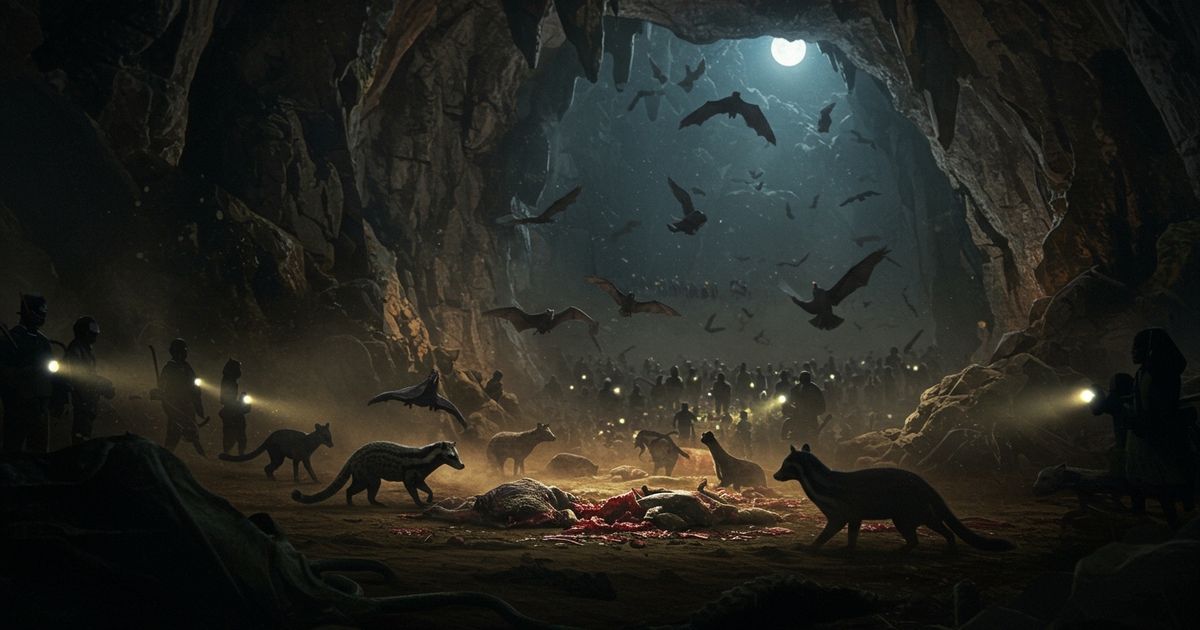
A Cave, a Camera, and a Killer Virus
Every year, thousands of people visit a cave in Uganda. They go to see the bats. What they might not realize is that something invisible — and potentially deadly — could be making the journey home with them.
Scientists recently set up cameras inside one of Africa’s most notorious caves, and what they captured on film is giving us a stunning new window into how some of the world’s scariest viruses jump from animals to humans.
What Makes This Cave So Special (And So Dangerous)
The cave in question is a known hotspot for Marburg virus — a pathogen so dangerous it reads like something from a disaster movie. Think of it as Ebola’s close cousin. Both cause severe hemorrhagic fever, which basically means the virus attacks the body so aggressively that it can cause bleeding from multiple organs. Marburg has a fatality rate that can exceed 80% in some outbreaks. There is no approved cure.
The natural home of Marburg virus is believed to be Egyptian fruit bats — large, dog-faced bats that roost in enormous colonies inside caves across Africa. The bats carry the virus but don’t get sick from it. In other words, they’re like living storage units for the pathogen, going about their daily lives while harboring something that can be catastrophic for humans.
But here’s the mystery scientists have been trying to crack for years: exactly how does the virus get from a bat to a person? The gap between “virus lives in bats” and “virus causes a human outbreak” has a lot of missing steps. Filling in those steps could be the key to preventing the next epidemic.
Lights, Camera, Spillover
To find answers, researchers did something elegantly simple: they pointed cameras at the cave and pressed record.
Over the course of their study, they filmed 10 different animal species either eating bats or scavenging bat carcasses inside the cave. We’re talking mongooses, civets, genets, birds of prey — a whole cast of wildlife treating the cave like an all-you-can-eat buffet.
This is a huge deal. Here’s why.
Think of virus transmission like a game of telephone. The original message (the virus) starts with the bat. For it to eventually reach a human ear, it needs to pass through a chain of “players.” Scientists had long suspected that other animals might be acting as middlemen — picking up the virus from bats and potentially passing it on to humans or other animals downstream. These go-betweens are called intermediate hosts, and finding them is like discovering a secret passageway in a maze.
The camera footage gives researchers the first real visual evidence of which animals are in that chain and how often they’re interacting with bats. A mongoose gnawing on a dead bat isn’t just a cool wildlife moment — it’s a potential virus handoff happening in real time.
The Human Surprise
Here’s where the story gets uncomfortably close to home.
Along with all the wildlife footage, the cameras also caught hundreds of human visitors entering the cave. Tourists. Locals. People who simply wanted to see one of nature’s great spectacles — millions of bats hanging from a cave ceiling, which is genuinely breathtaking.
But these visitors were walking directly into a space where bat blood, saliva, urine, and feces are essentially everywhere. Bats roost overhead. Carcasses litter the ground. Other animals come and go, potentially leaving traces of virus-contaminated material behind.
Basically, imagine wandering into a room where someone has been sneezing on every surface — except the “sneezing” is happening on a scale of millions, and the germs can be lethal.
The researchers weren’t pointing fingers at tourists. The point was more unsettling: we didn’t really know this was happening at this scale. Before the cameras went in, nobody had a clear picture of just how many people were regularly visiting these high-risk locations. And without that picture, public health officials can’t design warnings, protective gear recommendations, or monitoring systems that actually work.
Why This Changes the Game
For decades, the study of how viruses jump from animals to humans — a process scientists call zoonotic spillover (basically, a virus “spilling over” from the animal world into ours) — has relied heavily on blood tests and surveys after the fact. You wait for an outbreak, trace it back, and try to piece together what happened.
That’s a bit like trying to understand a car crash by only looking at the wreckage. Useful, but limited.
What these cameras offer is something rare: footage of the “crash” conditions before anything goes wrong. You can see which animals are present, how they interact, how often humans show up, and even at what times of day activity peaks. It’s a completely different kind of data.
This approach — essentially setting up wildlife cameras at known virus hotspots — could become a template for disease surveillance around the world. There are other caves, other bat colonies, other viruses (including coronaviruses, the family that gave us COVID-19) that follow similar patterns. If we can watch these ecosystems in action, we might spot warning signs before a virus makes the leap.
The Bigger Picture
There’s something profound lurking underneath this research. Viruses like Marburg haven’t suddenly appeared out of nowhere — they’ve existed in bat populations for potentially millions of years. What’s changed is us. Humans are venturing deeper into wild spaces, building closer to wildlife habitats, and creating more opportunities for these ancient viruses to find a new host.
In other words, every time we enter a cave full of bats, we’re inserting ourselves into an ecological web that was doing just fine without us — and we’re doing it without fully understanding the rules.
The animals caught on camera weren’t doing anything wrong. The mongooses and civets are just eating. The bats are just roosting. Even the human visitors are just curious. But curiosity, it turns out, can have consequences we can’t see with the naked eye.
What Comes Next
The researchers behind this study are calling for more camera surveillance at high-risk sites across Africa and beyond. They also want to combine this visual data with genetic testing of the animals caught on film — to see whether the wildlife visitors are actually picking up the virus, not just potentially could be.
There are also bigger questions worth asking. Could some of the animal species filmed become new reservoirs for Marburg? Are there seasonal patterns to when the virus is most active? Could simple interventions — like barriers, guided pathways, or protective equipment for visitors — dramatically cut human exposure?
None of these questions have answers yet. But for the first time, we have eyes inside the cave.
And sometimes, simply being able to watch is the first step toward keeping people safe.