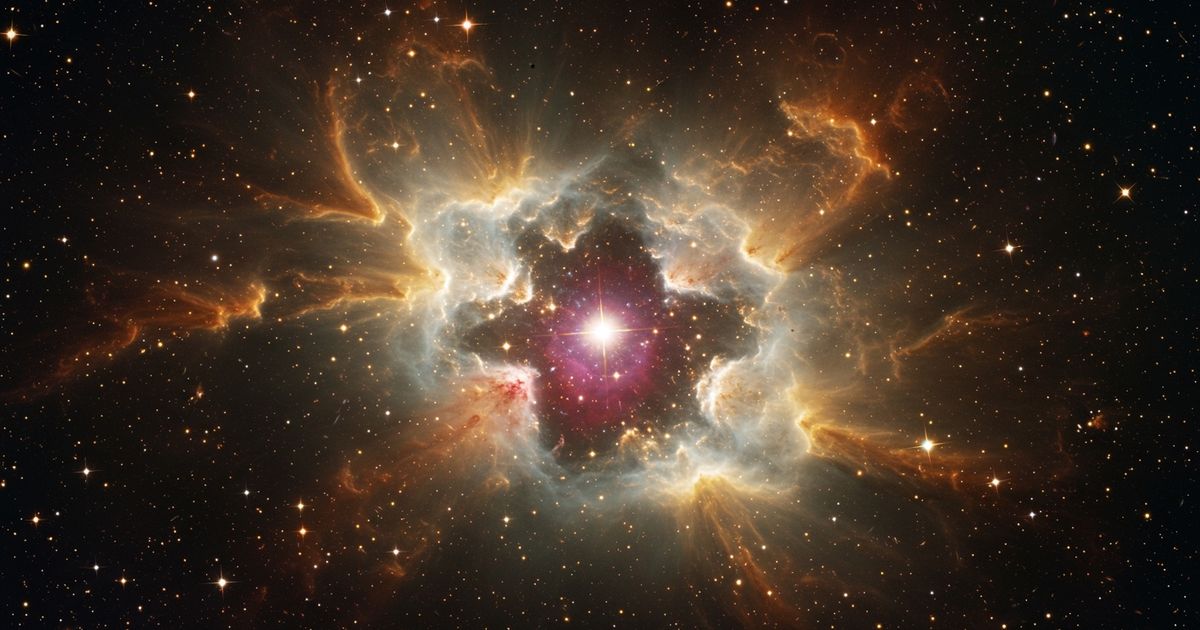
The Universe’s Very First Stars May Have Finally Been Found
Imagine if you could find the very first campfire ever lit by a human. Not a replica. Not a drawing of one. The actual, original flame. That’s essentially what astronomers may have just done — but for the entire universe.
Thanks to the James Webb Space Telescope, scientists think they’ve spotted the strongest evidence yet for the universe’s very first generation of stars. And the discovery is rewriting what we thought we knew about how the cosmos came to life.
Before There Were Stars, There Was… Nothing Much
To appreciate how wild this finding is, you need to understand what the early universe actually looked like.
Right after the Big Bang — about 13.8 billion years ago — the universe was basically a hot, soupy fog of the two simplest ingredients imaginable: hydrogen and helium. That’s it. No iron. No carbon. No oxygen. None of the heavier stuff that makes up planets, rocks, or you.
Then, over hundreds of millions of years, gravity slowly pulled clumps of that hydrogen and helium together. Those clumps got denser and hotter, until — ignition. The very first stars switched on.
Astronomers call these ancient pioneers Population III stars. Think of them as the universe’s original campfire builders. They were almost certainly enormous — potentially hundreds of times more massive than our Sun — and they burned incredibly hot and fast. More importantly, they were the universe’s first factories for heavier elements. When they eventually exploded, they scattered those ingredients across space, seeding future stars, planets, and eventually, life.
Here’s the catch: we’ve never actually seen one. Until now, they existed only in our equations and computer simulations.
The Problem With Looking Back in Time
Spotting a Population III star is a bit like trying to see a candle that burned out 13 billion years ago. These stars formed so early and burned out so quickly that by the time we’ve developed telescopes powerful enough to look for them, they’re long gone.
Looking deep into space is the same as looking back in time. Light travels fast — about 186,000 miles per second — but the universe is enormous. So when we look at something very far away, we’re seeing the light that left it a long, long time ago. Peer far enough, and you’re essentially watching a cosmic home video from the dawn of time.
That’s exactly what the James Webb Space Telescope was built to do. It’s the most powerful space telescope ever launched, designed specifically to detect the faint, ancient light from the early universe. Think of it as the world’s most sensitive time machine — one that collects light instead of traveling through time.
The Discovery: Ancient Light From the Universe’s Infancy
Using JWST, astronomers found something extraordinary inside a distant galaxy cluster. Clustered around a small companion object — a sort of baby galaxy that formed just 400 million years after the Big Bang — was a pattern of light unlike almost anything seen before.
For context, 400 million years after the Big Bang is extremely early. If you compressed the entire history of the universe into a single 24-hour day, 400 million years in would be about 42 minutes after midnight. We’re talking about the universe when it was barely a toddler.
The light signature coming from this region had a very specific chemical fingerprint. Basically, the glow suggested the presence of stars made almost entirely of hydrogen and helium — with barely any heavier elements at all. That’s the calling card of a Population III star. It’s like finding a loaf of bread made with nothing but flour and water, no salt, no yeast — an ancient recipe from before anyone knew about those other ingredients.
The key chemical clue was an unusually strong signal from helium — specifically, helium that had been energized and “lit up” by extremely intense, hot radiation. Regular stars (like our Sun) don’t produce radiation quite that extreme. But the theoretical models for Population III stars? They do. These first stars would have burned so ferociously hot that they could ionize, or charge up, helium in a way that leaves a very distinctive glow.
In other words, the light coming from this region is almost too pure — too free of heavier elements — to be explained by any stars we know. It almost perfectly matches what physicists have long predicted Population III stars would look like.
Why This Changes Everything
This isn’t just a cool space fact. It’s a genuinely historic moment in our understanding of how everything came to be.
Think of Population III stars as the universe’s first chefs. Before them, the cosmic pantry only had two ingredients. These stars created the rest of the periodic table — carbon, oxygen, nitrogen, iron — by fusing simple atoms together in their cores. When they exploded, they scattered those new ingredients into the universe like a chef tossing salt into a pot.
Without them, there are no rocky planets. No oceans. No DNA. No you.
Finding direct evidence that these stars actually existed — rather than just assuming they must have because our models say so — is like finally finding a fossil of a creature that scientists had only ever theorized about. It validates decades of theoretical work and gives us a real anchor point for the story of cosmic history.
It also tells us something about where these first stars formed. The fact that they appear clustered around a small, dense companion galaxy suggests these ancient stars may have preferred compact, chaotic environments — the cosmic equivalent of a busy urban neighborhood rather than a quiet suburb.
What Comes Next?
Of course, science never hands you a clean, final answer.
This is described as the strongest evidence yet — not a 100% confirmed sighting. Astronomers are cautious for good reason. The universe is complicated, and there could be other explanations for this unusual light signature that haven’t been fully ruled out. Further observations and analysis will be needed to close the case.
But the excitement in the scientific community is real. JWST has only been fully operational for a few years, and it’s already overturning assumptions about the early universe left and right. Researchers now want to search for more regions with similar light signatures, building up a picture of just how common these first stars were and how they shaped the galaxies we see today.
There’s also a deeper philosophical thrill here. Humans have been looking up at stars for thousands of years, weaving stories about them, navigating by them, worshipping them. And now, for the first time, we may be looking at the very first ones that ever existed.
The universe had a beginning. Stars had a beginning. And for one brief, shining moment — thanks to a telescope floating in space — we can almost see it.