The Sun Could Crash Society — And It’s Not a Movie Plot
The sun is 93 million miles away. So why are scientists worried it could empty grocery store shelves and spark riots in the streets?
It sounds like the setup for a disaster film. But a new report warns that an extreme solar storm — the kind that hits Earth every few centuries — could do exactly that. And the scariest part isn’t the storm itself. It’s how we would react to it.
What Is a Solar Storm, Anyway?
Let’s back up. The sun isn’t just a giant ball of light sitting quietly in space. It’s a churning, violent, magnetically charged furnace that constantly shoots out streams of charged particles — think tiny, invisible bullets made of energy.
Most of the time, Earth’s magnetic field (imagine a giant invisible shield wrapped around our planet) deflects these particles. We’re safe. We don’t even notice.
But sometimes the sun has a bad day. A really bad day.
It can unleash a massive explosion called a coronal mass ejection, or CME. Think of it like the sun sneezing — except instead of germs, it fires a bubble of magnetized plasma the size of several Earths directly into space. If that bubble hits us, it slams into our magnetic shield and causes what scientists call a geomagnetic storm.
Minor geomagnetic storms happen fairly often. They’re responsible for the gorgeous auroras — the northern and southern lights — that occasionally paint the sky in greens and purples.
But the worst-case version? That’s a different beast entirely.
When the Sun Has Gone Too Far Before
History gives us a glimpse of how bad things can get. In 1859, a solar storm so powerful it became known as the Carrington Event struck Earth. Telegraphs — the 19th century’s version of the internet — burst into sparks. Operators got electric shocks. Some telegraph machines caught fire. And the auroras were so bright that people in Cuba and Hawaii could read newspapers by their light at midnight.
That was 1859. We didn’t have power grids, GPS, the internet, satellites, or smartphones back then.
Now we do.
A Carrington-level storm today would be catastrophic. GPS systems could go haywire, making navigation nearly impossible — for your phone, yes, but also for planes, ships, and emergency services. Power grids could fail across entire continents. Internet infrastructure could be fried. Satellites — the ones streaming your shows, routing your bank transactions, and enabling weather forecasts — could be knocked out.
Scientists estimate a severe storm could cause trillions of dollars in damage and take months, maybe years, to fully recover from.
The Hidden Danger: Us
Here’s where the new report gets really interesting — and unsettling.
Most disaster planning focuses on physical damage: broken transformers, downed satellites, corrupted data. But scientists are now warning about something we’ve largely overlooked: human behavior.
Think of it like a power outage in your neighborhood. The first hour, everyone’s calm. By hour three, people start getting a little anxious. By day two, if the lights are still out, tempers flare. Stores get overwhelmed. Rumors start spreading.
Now imagine that, but on a continental scale, lasting weeks.
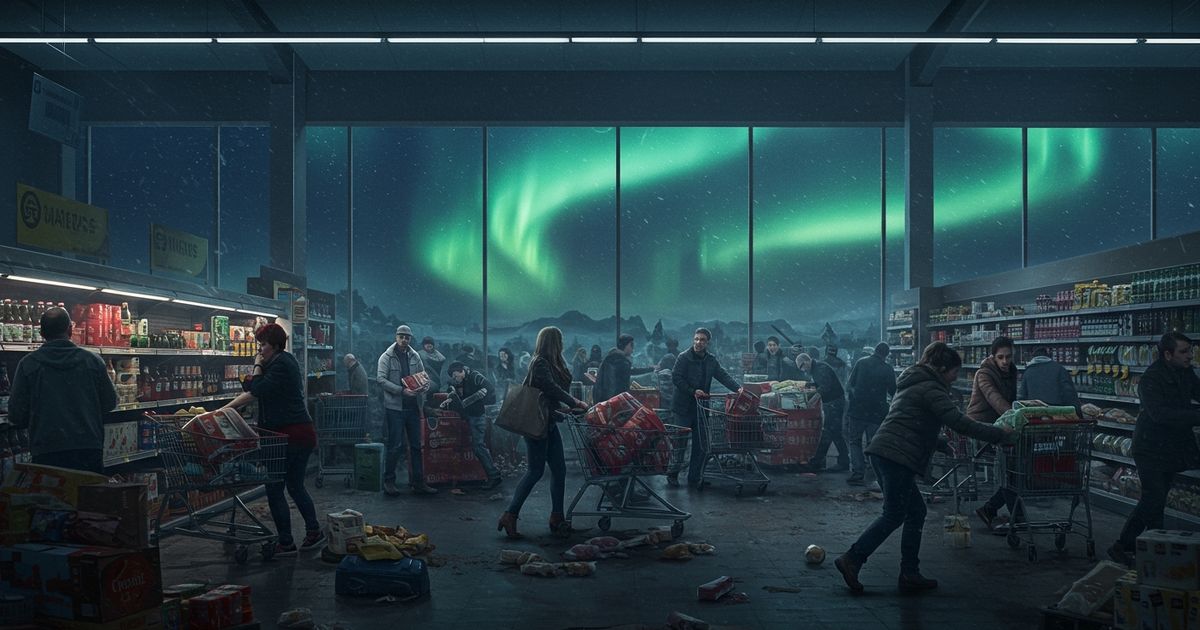
The report warns that a worst-case solar storm could trigger a cascade of social problems. We’re talking panic buying — the kind we saw at the start of the COVID-19 pandemic, when store shelves were wiped clean of toilet paper and canned goods within days. We’re talking public unrest, protests, and the breakdown of social trust. And we’re talking about a tsunami of misinformation flooding social media as people try to make sense of a confusing, frightening situation.
In other words, the storm doesn’t have to destroy the power grid to cause chaos. It just has to threaten to.
Why Misinformation Makes It Worse
Here’s a cruel twist. The very tools we’d use to communicate during a crisis — social media, messaging apps, online news — could become weapons of mass confusion.
We saw this during COVID, during major hurricanes, during wildfires. False information spreads faster than true information, especially when people are scared and desperate for answers.
Now imagine the power is flickering, your GPS is acting weird, and nobody official is explaining what’s happening clearly. Into that vacuum rushes rumor, conspiracy theory, and panic-amplifying posts shared by well-meaning but misinformed people.
The researchers behind this report argue that governments and agencies need to plan not just for infrastructure failure, but for information failure. Basically, the story people tell themselves about what’s happening matters almost as much as what’s actually happening.
Why This Research Matters Now
You might be wondering: if solar storms this severe only happen every few hundred years, why worry now?
Two reasons.
First, we are currently in a period of heightened solar activity. The sun runs on roughly an 11-year cycle of calm and storm. Right now, we’re near the peak of that cycle — called solar maximum — meaning the sun is more active and volatile than it has been in years. In fact, in May 2024, Earth experienced the strongest solar storm in two decades, causing auroras visible as far south as Florida and Mexico. Nothing catastrophic happened that time. But it was a reminder that these events aren’t ancient history.
Second, our civilization is far more vulnerable than it used to be. Every decade, we wire more of our lives into systems that rely on satellites and electricity and internet connectivity. Every new dependency is another potential point of failure when the sun decides to sneeze in our direction.
What Can We Actually Do?
The good news — and there is good news — is that solar storms don’t sneak up on us the way earthquakes do. Scientists can often detect a CME leaving the sun and have anywhere from several hours to a few days to prepare.
Think of it like a hurricane forecast. We know it’s coming. We have time to act.
But “time to act” only helps if we have a plan. The report calls for governments to develop clearer communication strategies for solar emergencies — basically, a playbook for how to talk to the public in a way that informs without triggering panic. It also calls for better international coordination, because a storm powerful enough to damage infrastructure in North America would likely hit Europe and beyond too.
On the infrastructure side, engineers are already working on ways to harden power grids against geomagnetic disruption — adding protective devices to transformers and building in more redundancy. Some countries have begun stockpiling spare parts for critical equipment that would take months to manufacture and ship in a crisis.
A Warning, Not a Prophecy
Here’s the thing. This report isn’t saying doom is inevitable. It’s saying we’re not ready — and that’s very different.
Humans are remarkably adaptable. We figured out how to survive ice ages, pandemics, and world wars. A solar storm, even a catastrophic one, wouldn’t end civilization. But the aftermath could be a lot messier and longer than it needs to be if we’re caught flat-footed.
The researchers want us to take this seriously before it happens — the way we should have taken pandemic preparedness more seriously before 2020.
Next time you look up at the sun setting over the horizon, painting the sky orange and gold, remember: it’s beautiful, it’s life-giving, and it is monumentally, spectacularly powerful. We’re lucky it’s 93 million miles away.
But every so often, that distance isn’t quite enough.